

Wimbledon ROI Analysis: Favourites vs Underdogs
Favourites +0.6%, underdogs -10.0% over 1,871 Wimbledon matches since 2010. Dogs still lose — but far less than at the Australian Open or Roland Garros. The likely reason: grass.

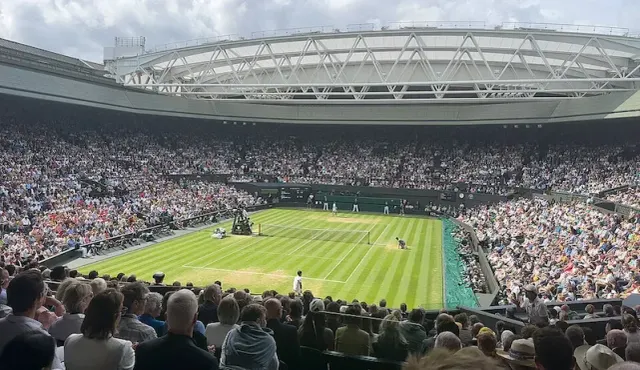
Do you have any intuition about whether underdogs or favourites perform better at Wimbledon? Is it possible that more upsets happen at Wimbledon than usual, given that it's such a unique surface and players only compete on it for a few weeks each year?
Well, I have the data, which I'll share with you below. At the end, I'll give you my opinion on it.
This is the performance of Favourites and Underdogs in Wimbledon, since 2010 to 2025. I have used Pinnacle closing odds. 1 bet = 1 unit in all cases:

- ROI Favorites: +0.6%
- ROI Underdogs: -10.0%
That is, you would have made a 0.6% profit on your total stakes if you had consistently backed the favourites at Pinnacle’s closing odds, and you would have lost 10.0% if you had backed the underdogs. A total of 1871 valid matches.
You can see these type of analysis in my app https://favordog.io/.
Keep in mind that these results would improve if you used multiple bookmakers and betting exchanges. Still, the interesting part is identifying the potential biases that exist.
Looking at these results, one might conclude that underdogs perform especially poorly at Wimbledon.
However, we need to keep in mind that matches at Wimbledon are best-of-five sets, so any analysis should be compared with the other Grand Slams, since the particular nature of best of 5 set matches is key and cannot be overlooked.
In that context, the ROI for underdogs during the same period is around -3% at the US Open, but close to -20% at both the Australian Open and Roland Garros.
With the exception of the US Open—which I’ll analyze in August, when I’ll explain why I believe underdogs don't perform as poorly there—it’s important to highlight a key reason why underdogs tend to perform worse in Grand Slams: their average odds are much higher.
This brings us to the concept of the favourite–longshot bias. According to this bias, bookmakers apply significantly higher margins to longer odds. As a result, underdogs in Grand Slams tend to have much worse long-term ROI compared to other tournaments.
On average, the level gap between favourites and underdogs is larger, the odds difference is more pronounced, and since we're assuming a flat staking strategy (betting the same amount on both favourites and underdogs), the higher margins implied into the underdog's odds lead to long-term negative returns.
However, at Wimbledon, underdogs don’t perform as poorly as they do at Roland Garros or the Australian Open. This suggests that grass as a surface leads to more upsets—or more accurately, to more upsets than the market expects, compared to the other two Grand Slams.
This idea is supported by historical data showing that in non-Grand Slam grass tournaments, underdogs have historicall even yielded positive returns (+1.2% ROI from 2010 to 2026 in 2,827 bets vs -3.4% ROI for Favorites). In other words, it seems that grass indeed produces more surprises than other surfaces, and the market doesn’t fully account for this by adjusting underdog prices accordingly.
I’m not sure if I’ve managed to explain my thinking clearly, but to summarise: grass appears to reduce the negative ROI typically seen for underdogs in Grand Slam events, making Wimbledon somewhat of an exception. As I said before, the US Open is another story and I will talk about it in a few weeks.
So, in summary, although underdogs still have a negative expected value, it's less negative than in the other Grand Slams because grass is a more underdog-friendly surface.


