

When an Underdog Wins the First Set, How Often does he Lose the Match?
An underdog who takes the opening set looks like a safe bet. The data says otherwise — and what happens next depends on two things: how big an underdog he is, and whether it's best-of-3 or best-of-5.


In my newsletter yesterday (you can subscribe free here) I talked about first-set bets versus the money line. I promised I would dig into the data. So I did.
I searched my database. To keep it fair, I split the matches into two groups: best-of-3 and best-of-5. You cannot compare them directly, because a best-of-5 match works in a very different way.
Here is what the numbers say.
The big picture
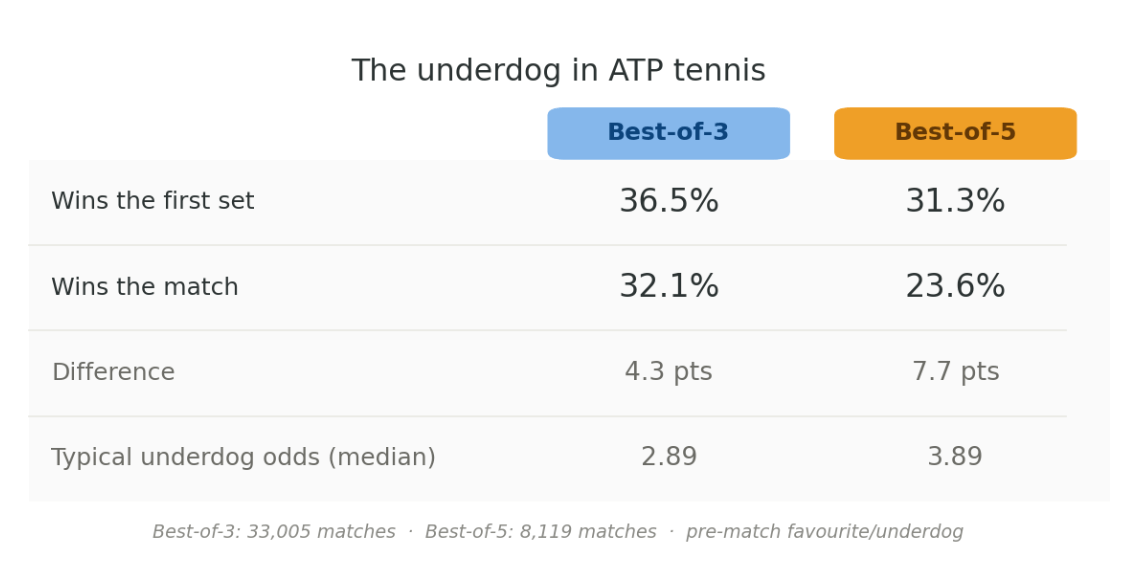
In best-of-3 matches, the underdog wins the first set 36.5% of the time, but wins the match only 32.1% of the time.
In best-of-5 matches, the underdog wins the first set 31.3% of the time, but wins the match only 23.6% of the time.
Now look at the gap between winning the first set and winning the match:
- In best-of-3, the gap is 4.3 points.
- In best-of-5, the gap is 7.7 points.
What does this mean in plain words?
Winning the first set is obviously worth less in best-of-5. In a Grand Slam, the favourite still has up to four more sets to turn the match around. In a best-of-3, one set is a much bigger part of the match.
One note on the odds. The typical (median) underdog is priced at 2.89 in best-of-3 and 3.89 in best-of-5. I use the median here, not the average, because a few huge longshots (odds of 50, 80, even 120) would pull the average up and give a false picture.
So the underdog in a Grand Slam is usually a weaker player to begin with. That is part of the reason he wins less often.
Now let's go deeper: by odds range
The numbers above mix all underdogs together. But not all underdogs are the same. A dog at 2.10 is a very different animal from a dog at 5.00.
So I asked a simple question: when an underdog wins the first set, how often does he still lose the match? And I split it by his pre-match odds.
Best-of-3 first:
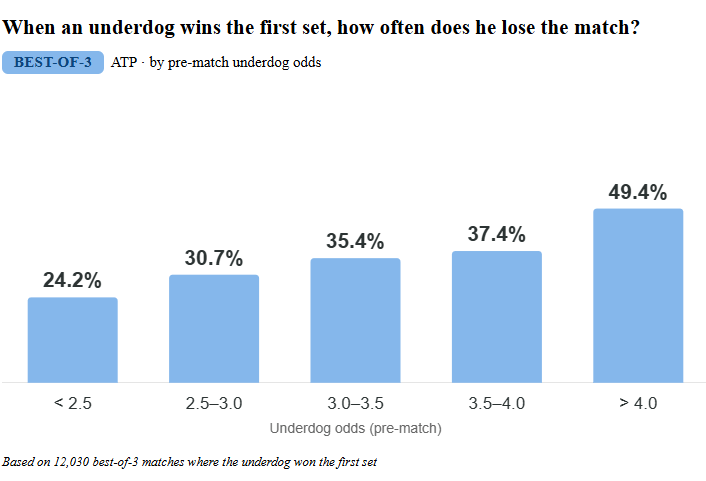
The pattern is clean. The bigger the underdog, the more often he wastes a winning first set. A small underdog (under 2.5) loses the match 24.2% of the time after winning set one. A clear underdog (over 4.0) loses almost half the time: 49.4%.
Now the same chart for best-of-5:
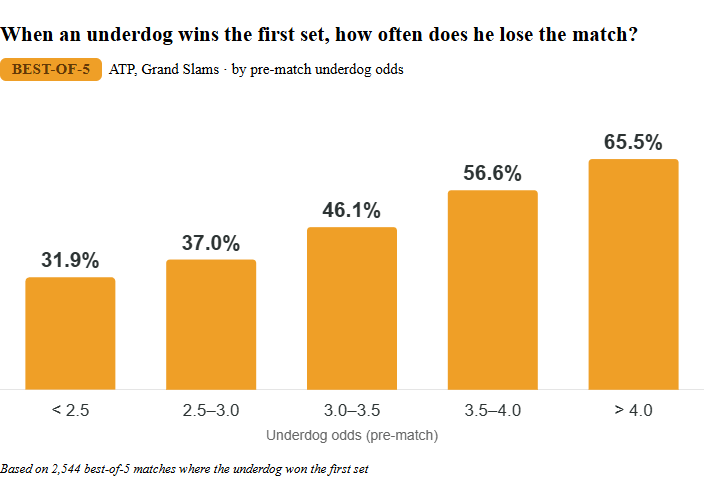
In a Grand Slam, winning the first set protects you even less. A clear underdog (over 4.0) who wins the first set still goes on to lose the match 65.5% of the time. That is two out of every three.
What this tells us
Winning the first set is good news for an underdog. But it is not the same as winning the match, and it means much less when two things come together: the player is a big underdog, and the match is best-of-5.
So next time you see an underdog take the opening set, ask yourself two questions before you get excited: how big an underdog is he, and is this best-of-3 or best-of-5? The answer changes everything.
These statistics may help you determine whether a first-set bet or a match-winner bet offers the better opportunity.


