


If you're primarily an underdog bettor, this is for you. And if you are not, you should know this info too.
Did you know Roland Garros is the ATP tournament where the fewest upsets occur?
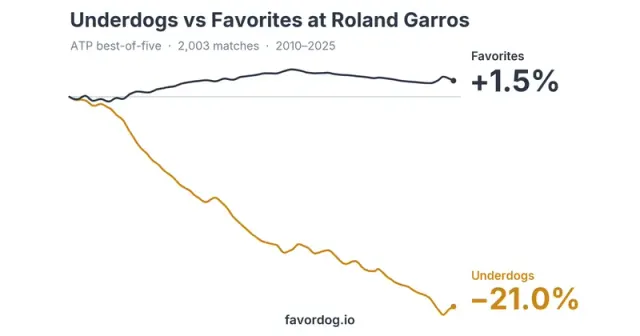
Or rather — the tournament where, if you had blindly bet on every underdog from 2010 to 2025, you would have lost a fortune. And if you had blindly bet on every favorite, you would have roughly broken even or made a small profit.
- Favorites ROI: +1.5%
- Underdogs ROI: -21.0%
I know what you're thinking. Nobody bets every underdog in a tournament. Fair. But there's a bias against them that you need to factor into your long-term thinking.
I ran a historical simulation using closing odds from Pinnacle for every Roland Garros men's match since 2010. 2,003 matches. Here's what the data shows.
What the breakdown actually says
A few things worth to mention:
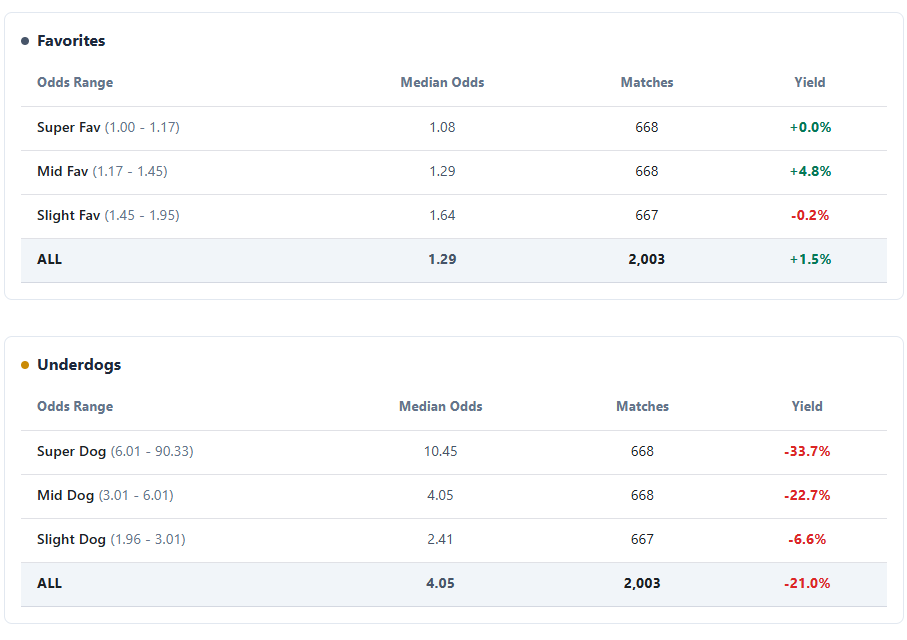
- Underdogs lose as the price goes up. Slight Dogs (1.96–3.01): -6.6%. Mid Dogs (3.01–6.01): -22.7%. Super Dogs (6.01+): -33.7%. The longer the shot, the higher the bleed. With 2,003 matches, the overall -21% is well past any reasonable significance threshold — this isn't variance.
- The +1.5% for favorites needs some context. Super Favs (1.00–1.17) yield 0.0% — essentially the fair price. Slight Favs (1.45–1.95) yield -0.2% — also fair. The entire favorite-side edge is concentrated in Mid Favs (1.17–1.45), at +4.8%. That's the cut of the market that might be visibly mispriced.
I should say: the +1.5% overall yield on favorites isn't enough sample to call it a real edge on its own. The Mid Fav +4.8% is closer to a defensible finding,although we cannot disregard that it is just variance. The -21% on underdogs, by contrast, is statistically clear.
Why does this happen?
Two reasons, in my view.
1. The surface: clay. I have data from every ATP tournament confirming that upsets are harder to come by on clay in general. The reasoning is simple — longer rallies mean more chances for the better player to assert their quality. On faster surfaces, a hot serving day or a streak of winners can close the gap between players. On clay, that compounding effect doesn't work as well.
2. Best-of-5 format. On top of clay, we should consider the fact that these are best-of-five matches and you get the most underdog-hostile environment in tennis. A favorite has more time to recover from a bad set or two. I have data confirming that upsets are much less frequent across all Grand Slams compared to best-of-three events.
Aren't the bookmakers supposed to adjust for this?
So aren't bookmakers — and bettors, who move the closing lines — supposed to adjust for this? Are they stupid?
No. My read is they correct partially but not fully. The underdog prices are lower than they should be, but not low enough. The favorite side absorbs the offsetting adjustment, which is why favorite yields land near zero. Margin is applied to both sides — Pinnacle isn't giving anyone free money — but the persistent public bias against underdogs more than compensates for the favorite-side margin.
This is the favorite-longshot bias you've read about, amplified by surface and format.
What I'm not saying
A few things I'm not saying:
- I'm not telling you to blindly bet favorites at Roland Garros.
- I'm not telling you there won't be upsets this year. There will be.
What I am saying: long-term, betting many underdogs at Roland Garros is the highest-difficulty mode in tennis betting. I bet underdogs myself, and at Grand Slams — especially at RG — I tighten my selection criteria significantly.
So: be careful what you back during these two weeks.
FavOrDog
If you want this same breakdown for every ATP tournament and for every surface, round, type of tournament and time period— to see where favorites and underdogs have historically made or lost money across the tour — there's a free tool I built for this: FavOrdog.
This is the data most bettors ignore.


