

Tie-Break Performance: Who Thrives or Struggles Under Pressure?
Which ATP players overperform in tie-breaks relative to their level? Comparing tie-break win % against games won % reveals some surprising names — including Nadal.

Yesterday I posted on X that Hanfmann, after losing a 1st set tie-break to Blockx in Munich, moved to a 29–52 record in tie-breaks — just 35.8% over his career. And this is reallt low percentage for a player.
In my opinion, Tie-breaks are a signal of a player’s mental strength… or weakness.
Yesterday I also shared in X a chart comparing Tie-break win % vs Match win % for current Top 100 players. But then betting analyst Joseph Buchdahl asked whether I had the same comparison using games won % instead of matches won %. I ran it.
And I think this is in fact a better comparison. Why?
Because games won % captures underlying performance far better, as it reflects what happens point by point across the entire match, not just the final outcome. Over a large sample, it’s one of the best proxies we have for true player strength. And that matters here.
Because what we’re trying to isolate is whether a player is overperforming or underperforming in tie-breaks relative to his level.
Measuring Tie-Break Performance Against Underlying Strength
And here are the results:
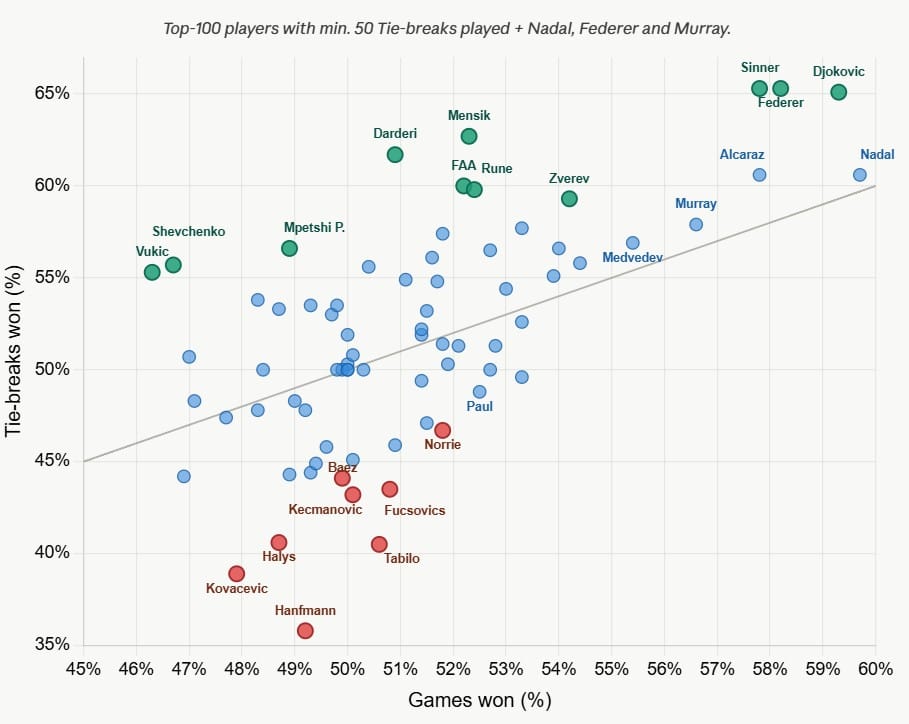
These are the Top 100 players with at least 50 career tie-breaks (71 players). I’ve also included Nadal, Federer and Djokovic to compare them with Alcaraz and Sinner.
Players above the diagonal win a higher % of tie-breaks than games.
Identifying Overperformers and Underperformers
Red players specially underperform in tie-breaks, while green players specially overperform, relative to their % of games won.
As you move to the right (higher-level players), the number of players overperforming in tie-breaks increases. That makes sense — the best players also tend to be better in key moments like tie-breaks.
The further above the diagonal, the better, the stronger his tie-break performance relative to his level — lower % of games won, but higher % of tie-breaks won.
As you can see, players like Darderi and Mensik do it particulary well. However, the number of tie-breaks played is relatively low, 60 and 75 respectively. It's very likely that, even though they do better than average, they won't hold these numbers going forward.
Among the top players, Sinner stands out the most in this regard: 57.8% of games won and 65.3% of tie-breaks won.
Federer follows with similar numbers. Djokovic wins a similar % of tie-breaks, but also wins a higher % of games, so relatively speaking his tie-break performance is slightly less impressive.
As for Nadal and Alcaraz, while they do win a higher % of tie-breaks than games (as expected), their performance is clearly below that of Sinner, Federer and Djokovic.
Alcaraz wins roughly the same % of games as Sinner, but about 5 percentage points fewer tie-breaks, suggesting a clear underperformance. That said, both Alcaraz and Sinner still have relatively small samples compared to others, so these numbers could shift — likely upwards — over time.
The Nadal Paradox
Nadal is clearly the weakest case here. He has the highest % of games won, but one of the lowest tie-break win rates among top players — around 60%. This may come as a surprise, given how widely his mental strength has been recognised.
Part of the explanation is structural. As a dominant clay-court player, he accumulates a very high % of games won on a surface where tie-breaks are far less frequent. That inflates his games won % relative to players who play more on grass and hard courts — where tie-breaks occur more often, and where Federer and Djokovic have built a large share of their statistics.
That said, he does convert around 5 percentage points fewer tie-breaks than Federer or Djokovic — though part of that gap is likely explained by the structural factors above.
More robust analysis coming soon
Finally, even though I have set a minimum of 50 tie-breaks, dispersion is still quite high for players in the 50–100 range.
In a future post, I’ll run a more statistically rigorous study using historical players (not just active ones) with a minimum of 200–300 tie-breaks.


