

Should You Bet Against Last Week's Finalists?
We dug into 910 matches since 2010 to find out when betting against a finalist actually pays — and when it doesn't.

Last week there were three ATP tournaments, so six finalists.
Three of them have already played their first match this week, Collignon, Merida and Dzumhur. All of them lost.
Another one, Tsitsipas, is not playing this week. And the other two finalists, Rublev and Darderi, are playing today.
We all have the same feeling: a final demands a big physical and mental effort, and the player often pays for it if he plays another tournament a few days later.
Be honest, you have probably made this bet at some point, betting against the player who came from playing a final the week before. Haven't you? :-)
I've done it many times :-).
But is this a profitable strategy, or just a feeling?
Because the market is not stupid. If the fatigue is real, the odds probably already include, at least, part of it.
Well, let's look at the data.
The big picture
I have taken every ATP 250 and ATP 500 final since 2010, and followed each finalist's first match the following week, if they entered another tournament.
I have left out Grand Slams and Masters 1000 on purpose: those finals are played by the very top players, and their physical and mental resistance is different. Also, they almost never play again so soon.
So these are overall numbers, across 910 matches that meet this criteria:
| ROI | Median odds | |
|---|---|---|
| Betting against the finalist | −3.7% | 3.28 |
| Backing the finalist | −4.3% | 1.39 |
Both options lose money, so there is no easy profit here.
But the exact day matters. A lot.
Here is the interesting question: is it the same to play one day after the final as two, three or four days after?
That is, if the final was on Sunday, does it matter if the next match is on Monday, Tuesday, Wednesday or even Thursday?
Here is the data:
| Days after the final | Bets | ROI betting against | Median odds |
|---|---|---|---|
| 1 day | 5 | −8.8% | 1.75 |
| 2 days | 376 | +7.6% | 2.85 |
| 3 days | 443 | −13.1% | 3.74 |
| 4 days | 86 | −5.1% | 4.11 |
| All | 910 | −3.7% | 3.28 |
Some comments:
The 1-day row is there to be complete, but five bets mean nothing. Players almost never come back that fast.
Look at the two rows with a real sample: two days and three days of rest.
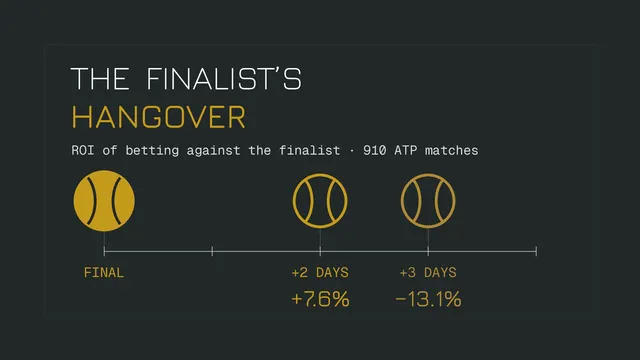
Betting against finalists who played again after two days gave a +7.6% ROI. The same bet one day later lost −13.1%.
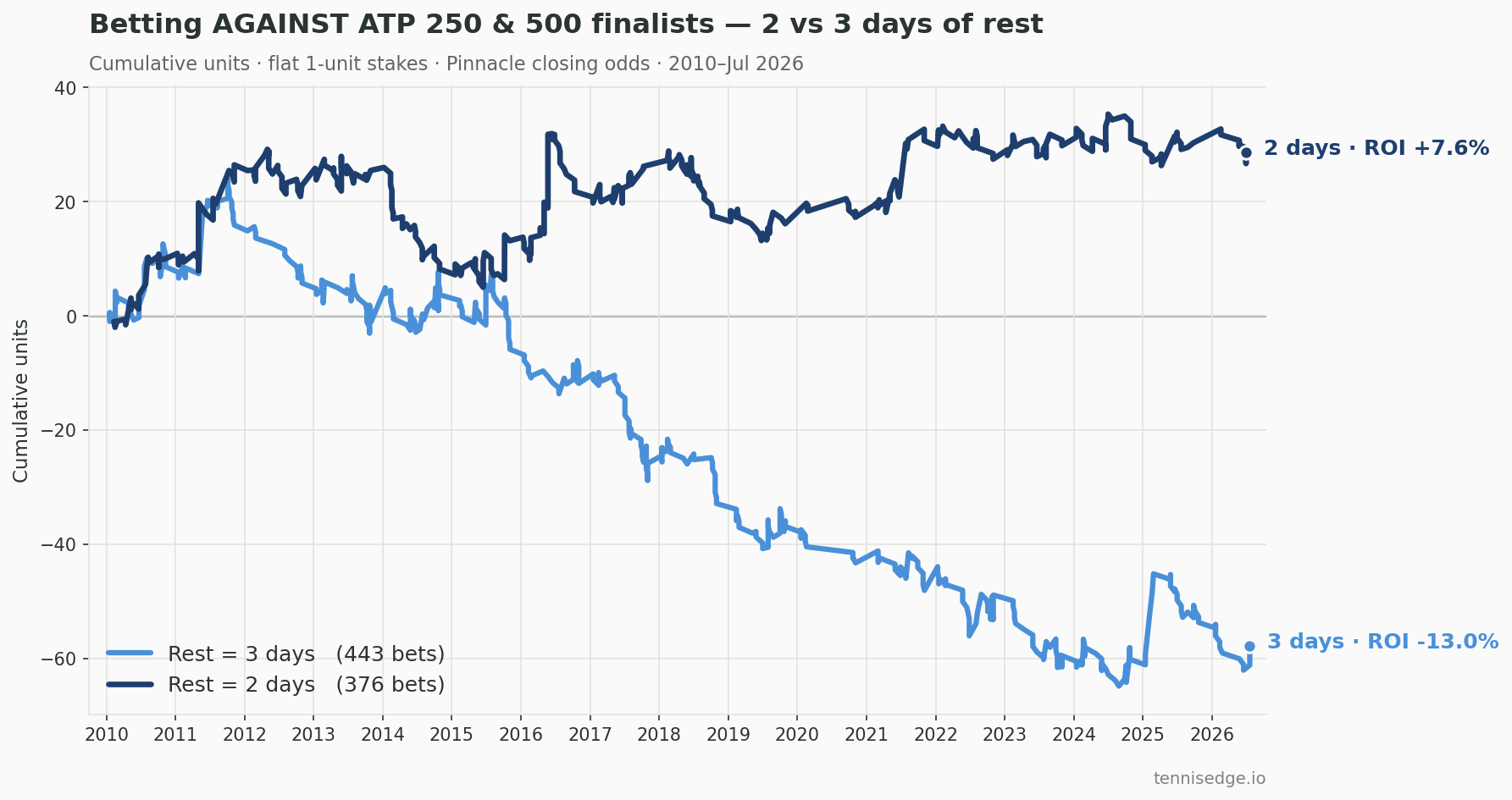
The chart shows it very clearly: two lines that separate early and never cross again.
What can we conclude?
A few conclusions.
- One extra day of recovery changes everything. Betting against a finalist who plays just two days after a final has historically been profitable. Give that same player one extra day of rest, however, and the edge disappears. In fact, finalists playing three days later have tended to outperform their odds.
- There is variance. We're talking about a few hundred bets, not thousands, so the results are not guaranteed. And as the dark blue line shows, there have been long periods, including the last seasons, where the strategy barely made any progress.
- And no, day 3 is not a goldmine in the other direction. Since betting against day-3 finalists loses -13.1%, maybe you are thinking that backing them gives a positive ROI. Almost: it lost -0.7%. Not a profit, but very close to break-even, and remember that the bookmaker's margin alone costs you around 2-3%. So if there is a bias on day 3, it points in favor of the finalist, not against him: with that extra day of rest, he seems to do slightly better than the market expects. Just not enough to make money backing him blindly.
Of course, there are many details we are not measuring: did the player travel from another continent, did he change surface, did he play long and hard matches in the previous tournament or easy ones?
But we cannot filter much more, because the sample would become too small.
Still, the general idea makes sense: when a player has very little time to recover, and very little time to practice on the courts of the new tournament, betting against him looks like a better decision than backing him. And the turning point seems to be between two and three days of rest.
The takeaway
So yes, there seems to be a real bias against finalists who play again only two days later.
But a bias is not a guarantee, and nobody should expect to make money betting this blindly.
Think of it as a tide that runs quietly in your favor and then use the details of each case (the travel, the surface, how hard the previous week was) to decide when it is worth using.


