

US Open: the only Grand Slam where favorites don't pay
For 16 years, backing favorites has quietly lost money at the US Open — the only Grand Slam where the market gets them wrong. Here is what the data shows.


Did you know that the US Open is the Grand Slam with the most upsets? Favorites win about 73.5% of the matches there. In the other three Slams they win around 77%. It may not look like a big difference, but for the betting market it is. Let me show you why.
The data
Everything below comes from Pinnacle closing odds for every ATP main draw match played since 2010 at the US Open, the Australian Open, Roland Garros and Wimbledon, up to and including Wimbledon 2026. Men only. That is over 8,000 matches, around 2,000 per tournament. Two notes: Wimbledon 2020 was not played, and the US Open 2026 starts this week, so obviously its data is not here yet.
Betting every underdog with flat stakes
The first chart is a simple simulation: 1 unit on the underdog in every match. The number at the right of every line is the ROI.
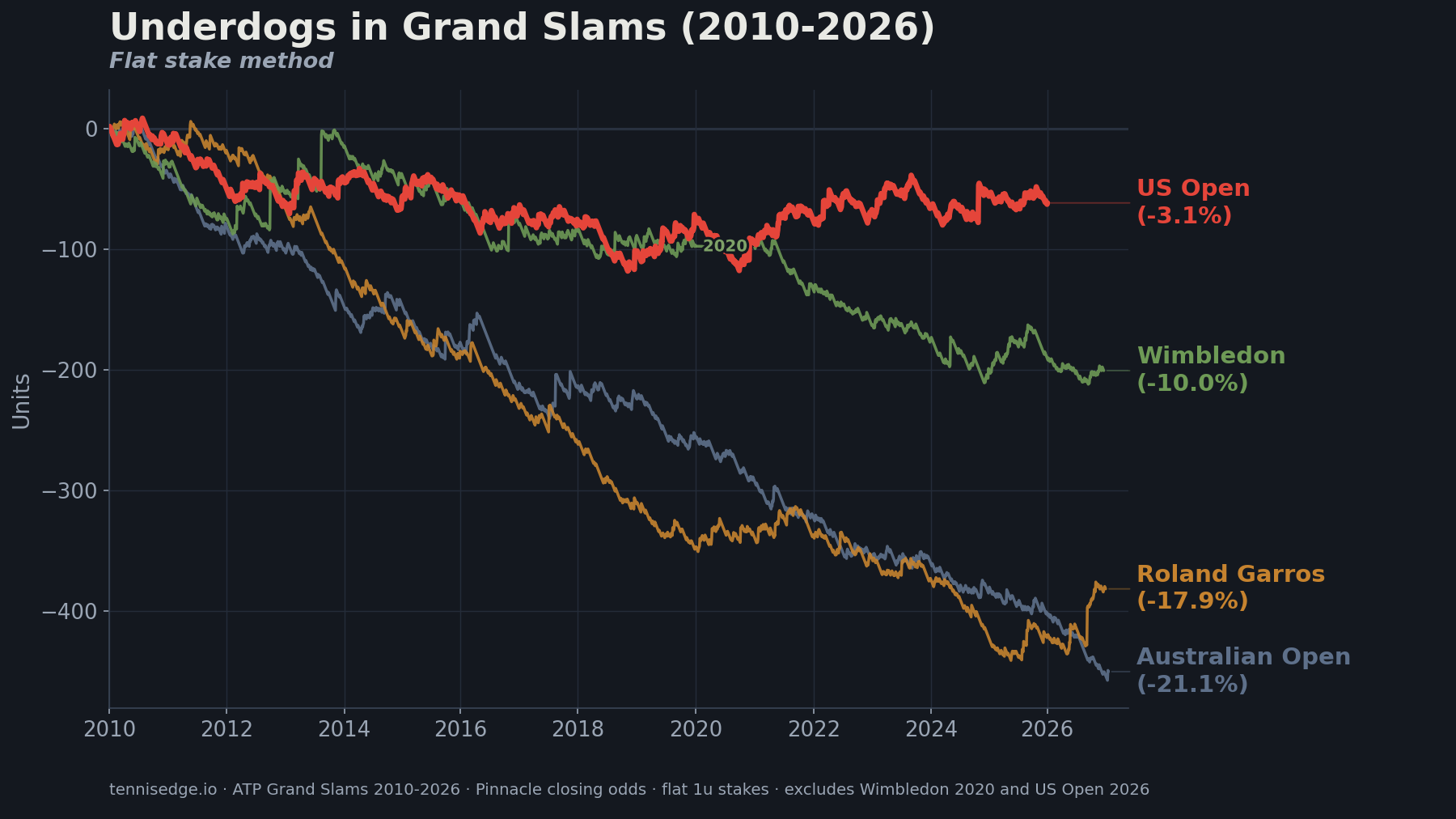
Looking at these numbers, it's clear that betting on underdogs in best-of-5 matches is generally a disaster. I'm not saying you should never do it, but you have to choose them very carefully, because the bias is clearly negative.
It is much harder for an underdog to beat a favorite over 5 sets than over 3, as the favorite has more time to recover from one or two bad sets. And it seems that the market does not adjust the odds enough to reflect this reality. This is the famous favorite-longshot bias, and Grand Slams are the perfect place to see it in action.
Now compare them. The Australian Open loses 21% and Roland Garros 18%. Wimbledon loses 10%. But the US Open — the red line — loses only 3.1%.
What about the favorites?
Underdog stats can be distorted by a few big longshots. Favorite stats are much more stable, because their odds are low. So here is the same simulation, this time backing every favorite:
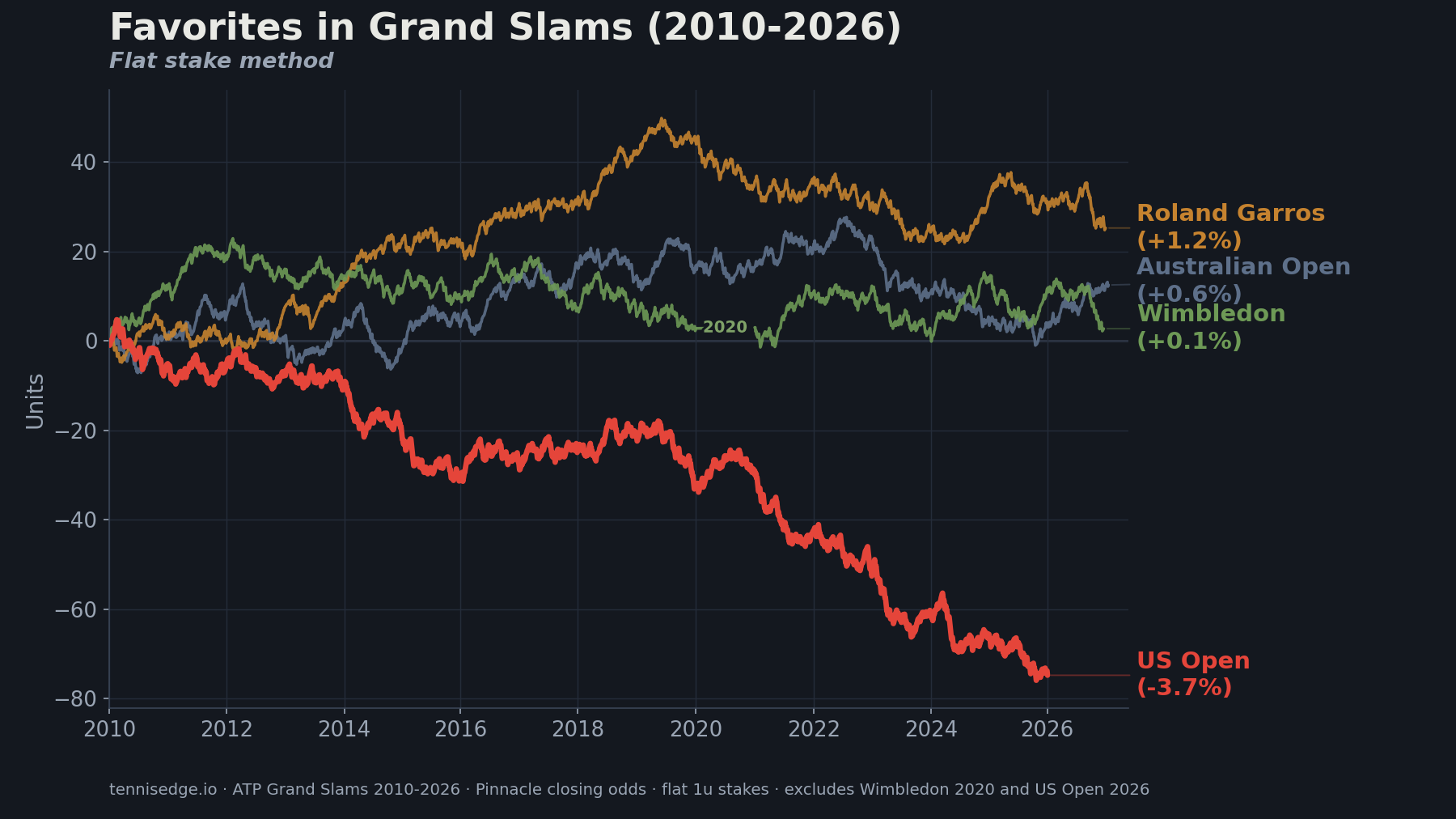
At Roland Garros, the Australian Open and Wimbledon, blindly backing favorites was break even or slightly profitable since 2010. To be clear, that does not make favorites a goldmine at those Slams either — they roughly break even, nothing more. The US Open is the only Grand Slam where favorites lost money: -3.7%. In fact, backing favorites there was a bit worse than backing the underdogs.
In other words: in three of the four Grand Slams, the difference between favorites and underdogs is huge, always in favor of the favorites. At the US Open there is basically no difference.
Is this just luck?
Fair question, so I ran the numbers.
Odds carry a probability inside. A favorite at 1.25 is expected to win about 4 times out of 5. Knowing this, I asked a simple question for every edition: did favorites win as often as their prices said they should? To make the comparison fair, I first removed the Pinnacle margin from every price.
At the US Open, favorites won less than their prices promised in 11 of the last 16 editions. At the other three Slams, that only happened in 1 out of every 4 editions, more or less.
Could this still be luck? I checked it with a classic statistical test. I mixed the 8,000 matches of the four Slams, drew random groups of the same size as the US Open, and measured the difference between the group and the rest. I repeated this 50,000 times. A difference as large as the real one appeared in less than 1 in 600 draws. This is not noise.
One thing must be clear, though. What is solid is that the US Open behaves differently from the other Slams. That does not mean US Open underdogs are a money printing machine. They are not.
Nobody bets flat stakes
Flat stakes are the standard way to present this kind of data, but nobody bets like that in real life. Nobody puts the same money on odds of 1.30 and on odds of 12.00.
A simple and more realistic alternative is to stake 1 divided by the odds: 0.77 units at 1.30, 0.50 units at 2.00, 0.08 units at 12.00. The logic is easy. If your bet wins, you make a bit less than one unit. If it loses, you only lose your small stake. So the difference between winning and losing any match is always exactly one unit, whatever the odds. That is why it is called unit impact. I will soon explain this staking method in detail in another post. You can see it as a middle way between flat stakes, where the loss is always one unit, and fixed profit staking, where the win is always one unit: with unit impact, what you can win and what you can lose add up to one unit. Every match has the same weight on your final result, and a couple of lucky longshots cannot distort the whole picture. The method was proposed in an academic paper by Barge-Gil and Garcia-Hiernaux, tested with real betting data: https://mpra.ub.uni-muenchen.de/92196. I will explain unit impact staking in more detail in a future post. But basically, it’s a method that more closely reflects how people actually bet in the real world
For the favorites, almost nothing changes, since their odds are close to 1 and their stakes are close to 1 unit anyway. For the underdogs, the picture changes a lot:
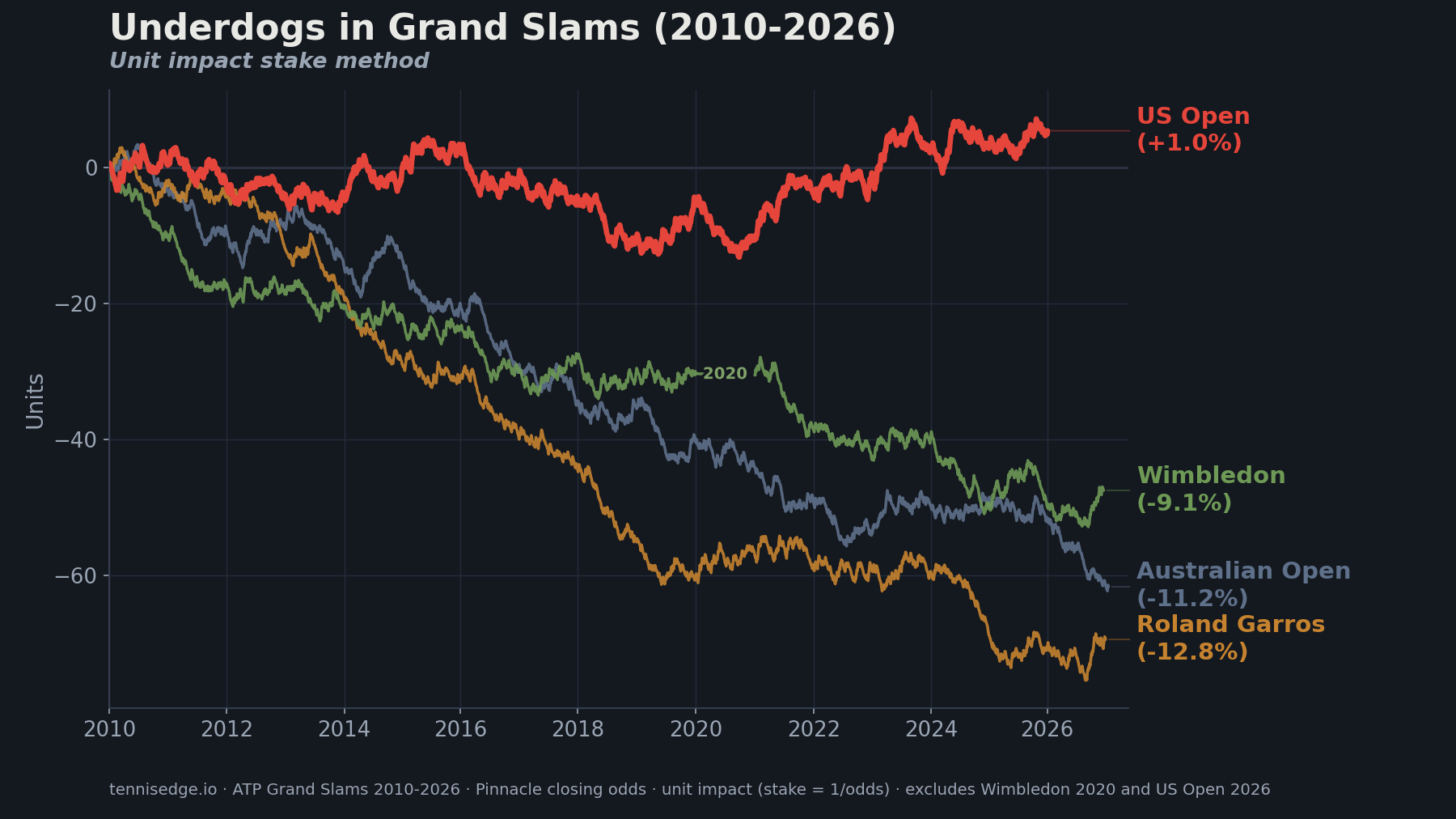
Roland Garros improves from -18% to -13%. The Australian Open goes from -21% to -11%. And the US Open moves from -3.1% to +1.0%. Yes, positive.
Don't get too excited. A +1% yield over 2,000 matches is statistically the same as zero, and in real conditions it would disappear. The honest reading is this: with a realistic staking method, blindly backing every underdog at the US Open since 2010 was break even. At every other Grand Slam it was a losing strategy.
One chart to see it all
This last chart shows the accumulated advantage of backing underdogs over favorites, match by match. When a line goes up, underdogs are beating favorites.
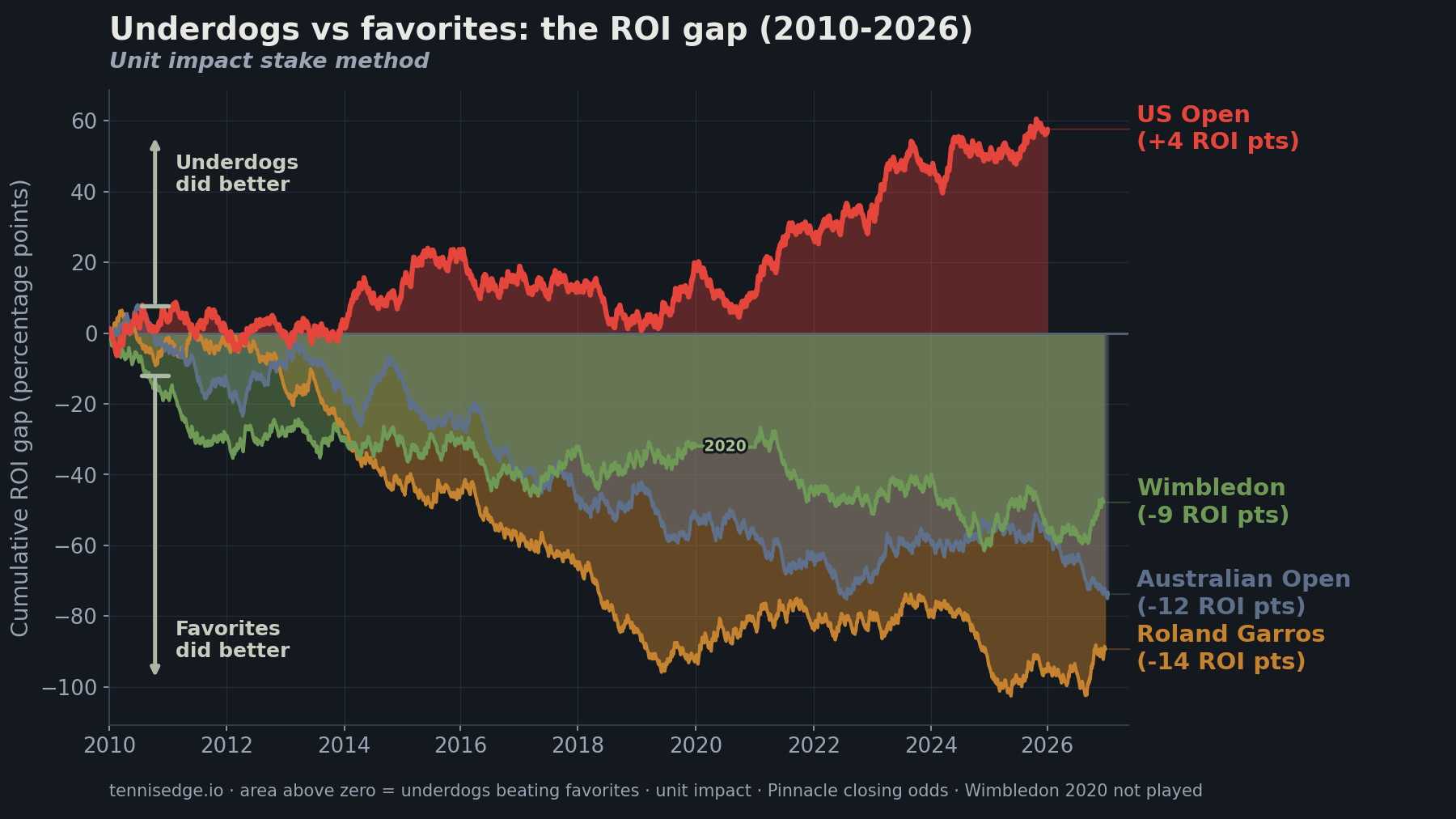
At Roland Garros, the Australian Open and Wimbledon, the line sinks and sinks. The US Open is the only one that stays around zero for years and then takes off. It is the only Grand Slam where, with unit impact staking, the underdog side beat the favorite side since 2010.
Is the pattern fading?
If anything, the opposite. In the last five US Opens (2021 to 2025), blindly backing underdogs was actually profitable: +5.4% with flat stakes and +9.4% with unit impact, while favorites lost 7.2%.
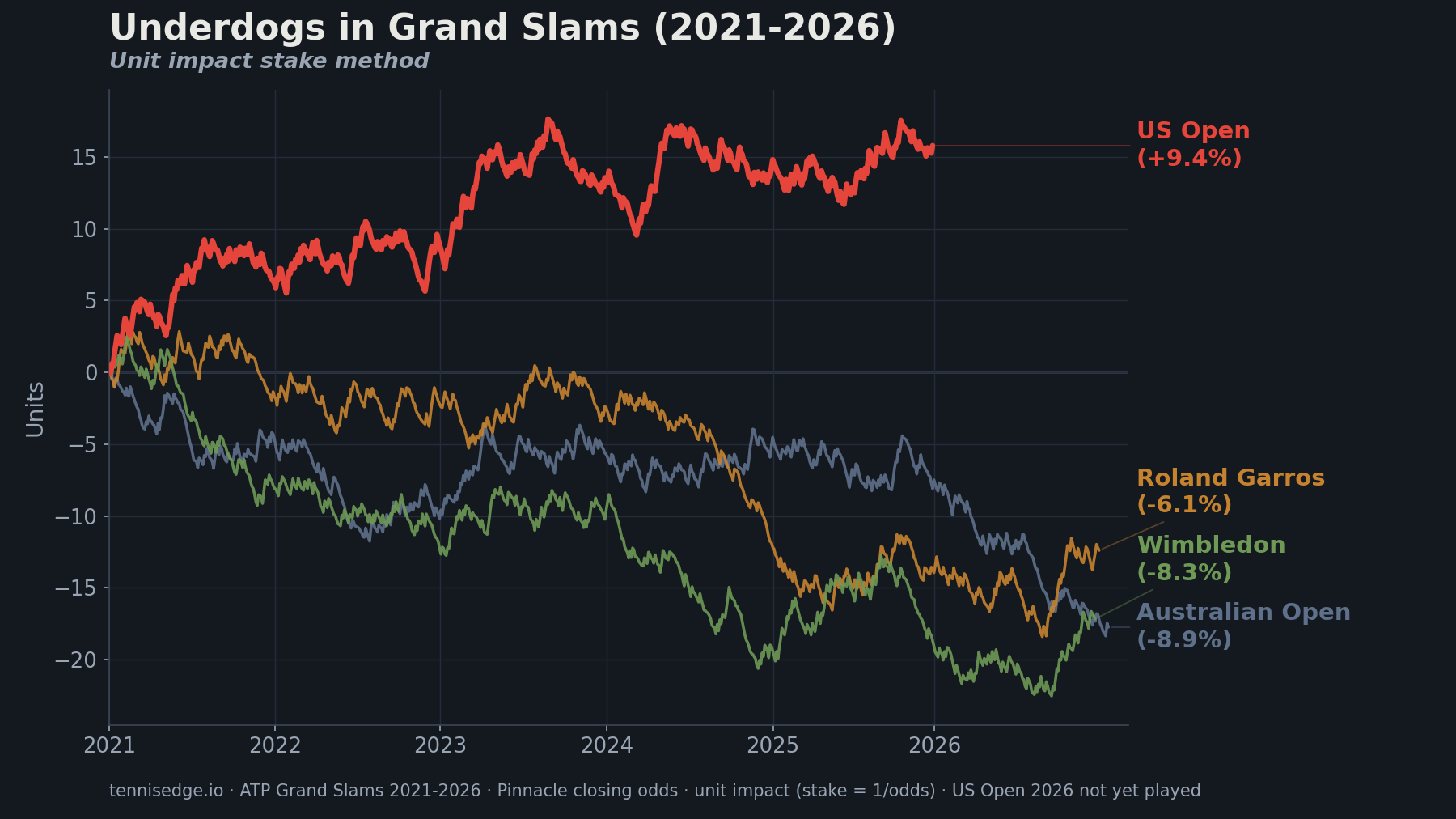
Look at the red line pulling away from the pack. In these recent years the other three Slams keep bleeding, and only the US Open turns clearly positive. Five editions is a short sample, so take this as a sign that the bias is alive and well, not as the new normal.
Possible reasons
Why does the market behave this way at the US Open? It's hard to say, and any statement here should be made with caution. I will give you two non-exclusive reasons why I think this could be happening:
- The weather. The humidity and heat in New York at this time of year are extreme, and this could have a real impact on the matches, leveling the field between the underdog and the favorite. If the market does not fully price this effect, underdog odds end up better than they should be.
- The point in the season. At this final stage of the season players carry a lot of physical wear, and tired favorites are easier to upset. Again, this only shows up in the results if the odds do not fully reflect it.
By the way, court speed alone does not explain it. Wimbledon is also a fast surface and underdogs still lose 10% there.
The other possible explanation is pure randomness, but as we saw above, the numbers make that hard to defend.
How I will use this info
As someone who mainly bets on underdogs, in Grand Slams I select my high-odds bets very carefully. I don't back underdogs as much as I do in other tournaments, because in the long run, if you bet on a lot of underdogs in Grand Slams, you are very likely to lose. It's hard to beat this market bias.
But at the US Open I won't be so cautious. I will let my pro-underdog bias express itself more freely.
Of course, it is possible that in this edition underdogs perform very poorly. We cannot predict that. But the data tells us that, over the long term, the US Open is the one Grand Slam where the market does not punish you for backing them. Fighting a double digit bias, like at Roland Garros or the Australian Open, is almost impossible. Fighting a break even market is a completely different game.
Once the US Open is over, I will share the favorites and underdogs numbers from this edition.
Where these numbers come from
Every number in this article comes from my own app, FavOrDog, and the charts are built on top of that data. It holds Pinnacle closing odds for every ATP match since 2010, and it lets you filter favorites and underdogs by tournament, surface, round and odds range, and see the yield of each cut in seconds. It also has a players section where you can check the historical ROI of more than 500 ATP players, one by one. It is the tool I use for my own betting.
You do not need to pay to start using it. There is a free option at favordog.io, so you can explore this same data yourself and find your own edges. If you bet on tennis, give it a try before this US Open.
Happy and profitable US Open!


