

Unit impact: the staking method where every bet matters the same
Nobody bets a 29.00 underdog like a 1.30 favorite. Unit impact is the staking method that admits it — and it changes how betting records read.

Nobody bets a 8.00 underdog the way they bet a 1.30 favorite. Every real betting history shows the same thing: the longer the odds, the smaller the stake.
And yet, many betting stats are calculated with flat stakes — including the ones I share on X and in many of my own analyses. Flat stakes means treating every bet the same: the same amount on Carlos Alcaraz at 1.01 and on Botic van de Zandschulp at 29.00.
That is not a mistake. Flat staking answers a precise question: did these bets beat the market, giving every bet the same weight? It makes results comparable across players and across time, and it stays the default in my stats. But there is a second question worth asking: what would a realistic bettor actually have experienced? This article is about a method that answers it: unit impact. What it is, how to use it, and why it deserves to be better known.
Three ways to size a bet
Forget the exotic systems. There are three simple ways to decide how much to bet.
Unit loss, better known as flat staking. You risk the same amount every time: one unit on everything. If you lose, you lose 1 unit. If you win, you win the odds minus one.
Unit win, or flat profit. You try to win the same amount every time. The formula: stake = target ÷ (odds − 1). To win 2 units at odds 5.00, you risk 0.50 units. To win the same 2 units at 1.25, you must risk 8 units. At very short prices this stops making sense: winning 2 units at 1.05 would mean risking 40.
Unit impact is the third way, and the reason for this article. It was proposed by two economists at the Complutense University of Madrid, Andrés Barge-Gil and Alfredo García-Hiernaux, in a paper published in the Journal of Sports Economics (2020). It deserves its own section.
What is unit impact?
The formula is one division:
stake = impact ÷ odds
The idea, in one sentence: the difference between winning and losing a bet is always the same, so every bet matters the same to you. That constant difference is the impact — the total effect any single bet can have on your bankroll — and it is what gives the method its name. With flat stakes, winning at 29.00 changes your bankroll 28 times more than winning at evens. With unit impact, no single bet can shake your bankroll more than any other.
Look at how it splits risk and reward. With an impact of 4 units: at odds 1.25 you risk 3.20 to win 0.80. At evens, you risk 2.00 to win 2.00. At 5.00, you risk 0.80 to win 3.20. Risk plus reward always add up to 4. You risk more when winning is likely, and less when it is not — which is what most bettors already do by instinct. Unit impact simply does it with discipline.
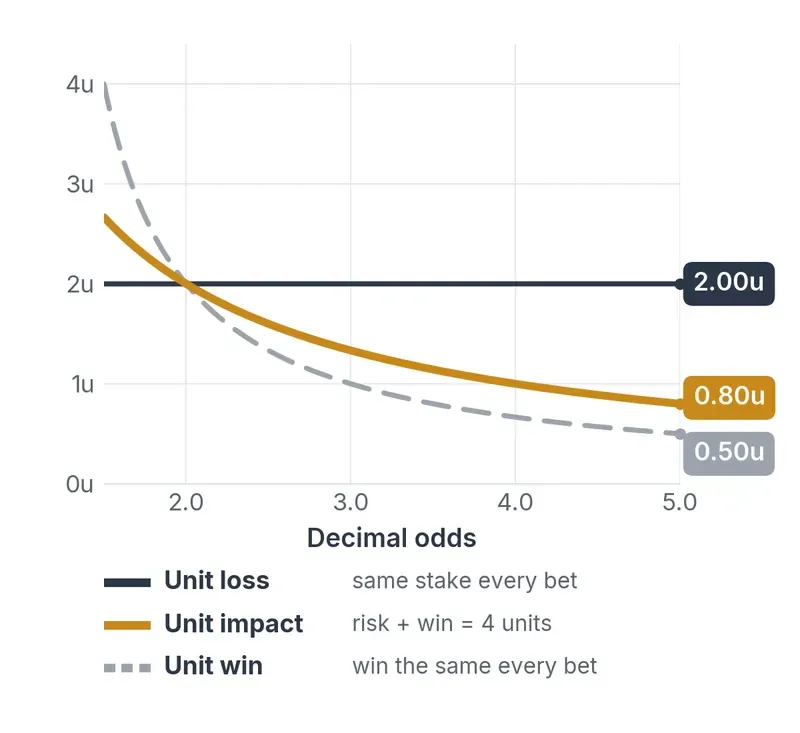
This chart compares how much each method stakes at every price. The three are set to bet the same amount at evens — 2 units per 100 of bankroll — so you can see how each one behaves as the odds move away from that point:
And the same comparison in numbers, now including the extreme prices where the differences get really big:
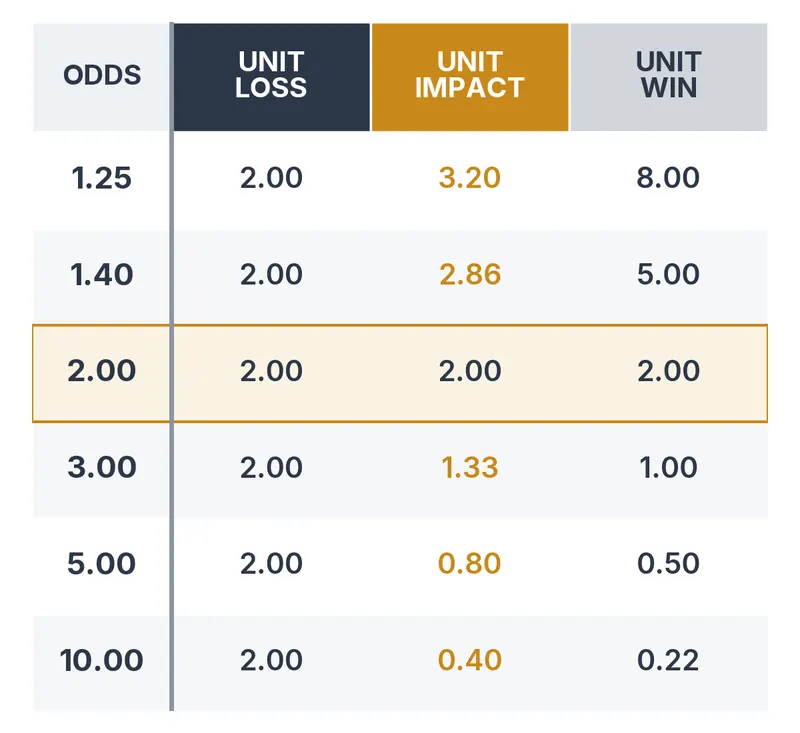
Where does unit impact sit? Halfway between flat stakes and flat profit — though closer to flat profit. Above evens, its stakes go down as the odds go up, almost like flat profit. The big difference is at short prices: flat profit explodes (8 units at 1.25, as the table shows), while unit impact stays calm and never risks more than your impact.
Every staking plan is a hidden claim about your edge
The theoretically perfect answer to bet sizing has existed since 1956: the Kelly criterion, which maximizes the long-term growth of your bankroll. The formula is short:
stake = edge ÷ (odds − 1)
where the edge is your expected profit per unit staked. With a 3% edge at odds 2.00, Kelly stakes 3% of your bankroll.
The problem is the word edge. To use Kelly you need to know the true probability of every event, and almost nobody — professionals included — trusts their estimates enough. Get the edge wrong and "optimal" becomes dangerous. So bettors use a simple rule instead.
Here is the part most people miss: a simple rule does not free you from assumptions about your edge. It hides them. Turn the Kelly formula around: edge = stake × (odds − 1). Whatever staking rule you follow, that rule is silently claiming an edge at every price:
- Flat staking claims your edge grows in a straight line with the odds. A 3% edge at evens becomes a 27% claimed edge at 10.00 — nine times bigger.
- Unit win claims your edge is exactly the same at every price, from 1.20 to 20.00.
- Unit impact claims your edge grows gently as odds rise and then levels off.
Which claim is closest to reality? You already know one big clue: the favorite–longshot bias. In most betting markets, returns do not get better as odds get longer; at the extremes they usually get worse. Barge-Gil and García-Hiernaux checked the three claims against tens of thousands of bets by professional tipsters on a large tipster platform. The real relationship between yield and price looked like the gentle curve — closest to unit impact, and nothing like the straight line that flat staking needs. In their simulations, the bankroll grew clearly faster under unit impact than under the other two plans.
One player, two views
Botic van de Zandschulp is the perfect example. In two seasons he produced two of the biggest upsets in tennis: Carlos Alcaraz at the 2024 US Open, 6-1, 7-5, 6-4 in the second round, at odds around 29.00, with Alcaraz as short as 1.01 — and Novak Djokovic at Indian Wells 2025, at odds around 7.00.
Backing him in every ATP match since 2021, the two views read like this:
- Flat stake: +18.4% overall, −0.4% as favorite, +34.7% as underdog.
- Unit impact: +5.3% overall, −0.6% as favorite, +15.6% as underdog.
As a favorite, both views agree almost exactly. As an underdog, flat staking shows more than double the yield of unit impact — and the reason is concentrated in one night in New York. With flat stakes, the Alcaraz match alone adds +28 units: twenty-eight evens wins in a single match. With unit impact, every bet moves the bankroll by the same amount, so that night counts exactly as much as any other match.
Note what the two views agree on: backing Van de Zandschulp as an underdog has been profitable in both. They only disagree on how much of that profit comes from two extraordinary nights — and on what a realistic bettor, staking less at 29.00 than at 2.20, would actually have won.
When the view matters — and when it doesn't
The Van de Zandschulp numbers show a general rule. The two views agree when the odds stay close to evens. They separate when the range of odds gets wider — and above all when the profit depends on a few bets at extreme prices. His favorite record (median odds 1.52, no extreme results) barely changes. His underdog record (median 2.82, with a 29.00 in the sample) changes completely.
The separation also exists at the short end, in the opposite direction: at 1.25, unit impact risks 1.6 times the flat stake, so a bad run of short favorites costs more with unit impact than with flat stakes. The wider your usual range of odds, the more this choice matters.
The trade-offs
Every staking method gives something and asks for something. Here is what unit impact asks — and what you get back.
It does not create value. No staking plan does. If your picks lose, they lose with any method; sizing can only manage an edge, not invent one.
Short favorites hit harder. You stake more below evens, so a bad run of favorites costs more than with flat stakes. In exchange, your stakes on longshots are smaller — so the losing runs that always come with high odds hurt much less.
Big-price winners feel smaller. A 29.00 winner pays less than double an evens winner. That is the price of the method's main gift: no single night can make or break your bankroll — in either direction.
It is not Kelly. But it is the closest simple rule to Kelly for a bettor who cannot estimate exact probabilities — which is exactly what the study found. And that bettor is almost everyone.
Choosing your impact
Start at evens. Decide what you would risk on a 50/50 bet — for most serious recreational bettors, between 1% and 2% of bankroll. Double that number and you have your impact. If you risk 1% at evens, your impact is 2 units per 100. From then on, every stake is one division: impact ÷ odds. At 2.50, bet 0.80 units. At 4.00, bet 0.50. At 1.50, bet 1.33. No tables, no software, no probability models.
If you trust your read: confidence levels
Everything above uses one impact for every bet. But maybe you believe you can tell your stronger bets from your average ones — not with a number, just with an order. Then you can let confidence adjust the impact.
Use two levels (normal and high) or three (some, normal and high), and give each one an impact, keeping them close: for example 2, 3 and 4 units. Keep the top level within double the bottom one. A wider scale — the 1-to-10 unit ladders of tipster culture — is really claiming you can separate a 2% edge from a 6% edge. Almost nobody can.
Three rules keep the system honest. One: normal is the default and high is the exception. If most of your bets are "high confidence", you do not have levels — you have a bigger impact with a different name. Two: the odds still do their work. A high-confidence bet at 4.00 (impact 4, stake 1.00) still risks less than a normal one at 1.60 (impact 3, stake 1.88). Three: put it to the test. Track each level separately, and if after a few hundred bets your high-confidence yield does not beat your normal one, your labels mean nothing — go back to a single impact.
This keeps the logic of Kelly — more edge, more stake — while asking much less of you. Kelly demands a number. Confidence levels only demand an order.
Both views in FavOrdog
This is why I built both views into FavOrdog. If you have never seen it: FavOrdog is my app for studying favorites and underdogs in tennis — how profitable it has been to back or fade any ATP player, filtered by period and surface. Today the flat stake / unit impact toggle lives in the Players section, and the Van de Zandschulp figures above are exactly what the app shows. Soon I will add it to the other two sections: Tour, the overall picture of favorites and underdogs across the whole tour, and Tournaments, the same picture event by event.
Flat stake stays the default because it is the standard measure and the fair way to compare. Unit impact sits next to it because sometimes you want the numbers to look like real betting.
The takeaway
Unit impact is one division: stake = impact ÷ odds. The difference between winning and losing stays the same on every bet — more money on likely winners, less on longshots, the way most people already bet, but with discipline.
It will not turn a losing bettor into a winner; no staking plan can. What it gives you is steadiness: no single night can make or break your bankroll, and your records start to look like real betting.
And when you compare the two views, remember: when they agree, you can trust the pattern. When they disagree, you have just learned where the profit really comes from — which is usually the more valuable discovery.
Nobody bets a 29.00 dog like a 1.30 favorite. Now your staking can admit it.


