

How Weather Affects Tennis Betting Odds
Zverev's price dropped sharply before facing Jodar. The likely cause was the rain forecast. Here is how weather can change the true odds of a tennis match.

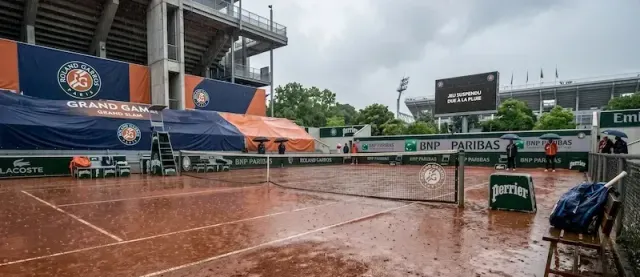
Most people think of weather as background information in tennis. Something that can delay a match, but not something that changes who wins. I think this is a mistake. Sometimes the weather can directly change the true probability of a match, and we can see it in the odds.
I want to use one example from this Roland Garros: the pre-match odds movement in Zverev vs Jodar.
The odds drop before Zverev vs Jodar
Zverev opened around 1.40 and then stabilised around 1.35. But from the day before the match, Monday 1 June, the price started to drop heavily. He moved from around 1.35 to around 1.25 at the close.
I am convinced the main reason was the weather forecast.
On Monday, the forecast for Tuesday started to change. Rain became more likely, and this is what happened. The probability of rain increased sharply, and I believe this was the main reason behind the move.
Why slower conditions favour the favourite
But why would rain help Zverev?
In theory, Jodar had a better chance of troubling Zverev in faster conditions. Shorter rallies, quicker points, a more direct match — these are conditions where the underdog has a better chance of creating an upset.
With rain, humidity and heavier conditions, the court usually becomes slower. The rallies get longer, the match becomes more physical, and the favourite has more time to impose his level.
In those conditions, Zverev becomes a clearer favourite. He has historically produced his best results on clay, and slower conditions reduce the randomness that could help a player like Jodar.
Turning the move into probabilities
So the move from 1.35 to 1.25 is not small.
At 1.35, the implied probability is around 74%. At 1.25, it is around 80%. If we adjust for the Pinnacle margin, the real probabilities would be slightly lower, but the idea is similar: Zverev probably moved from around 73% to around 79%.
That is roughly a 6 percentage point move. And this means Jodar's probability dropped from around 27% to 21%.
One match is not enough
Of course, we cannot know with certainty that, without the change in the forecast, Zverev's odds would have stayed at 1.35. Maybe they would have moved anyway. Maybe up, maybe down. We will never know.
In one single match, we cannot be precise. The 6 point move is the full revision of the market, and the forecast was probably not the only new information that day. So, if the forecast was the main new piece of information in that window, a reasonable estimate is that it increased Zverev's real probability by around 6 percentage points, from roughly 73% to 79%.
To measure this with precision we would need many cases, not one. The right approach would be to study thousands of similar matches and look at how closing prices move when the forecast changes, while controlling for other news. Then the average move would be the useful number.
Weather as a real betting variable
This is why weather is not just background information. Sometimes it can directly change the true probability of a match.
For a player like Jodar, fast and dry conditions were his best chance. The rain took that chance away before the first ball was played.
Finally, it rained and the match was played under the roof, what is another factor that can affect the result.


