

The Pre-US Open Masters 1000s: A Historical Edge for Underdogs
The two M1000 events leading into the US Open — the Canadian Open and Cincinnati — have historically favored underdogs over favorites. The gap reaches 12 points of ROI.

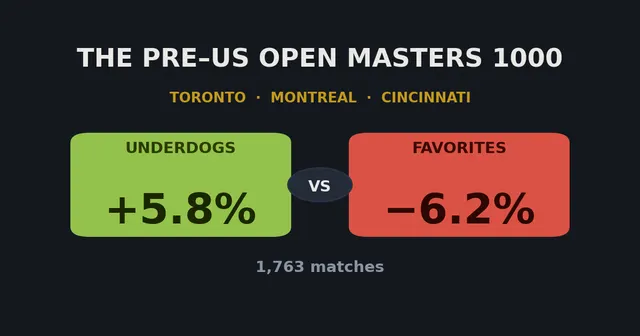
The Canadian Masters 1000 has historically been a favorable tournament for underdogs, both in Toronto and Montreal.
But Canada is not an isolated case.
Cincinnati, the other Masters 1000 played before the US Open, shows a very similar pattern.
In this post, I’ll look at the historical betting performance of underdogs and favorites in Cincinnati — and then combine the data from both pre-US Open Masters 1000s.
Cincinnati: Underdogs Have Outperformed
Since 2010, I have data for 848 matches. As always, using Pinnacle Sports closing odds and flat stakes, the ROI is:
- Underdogs: +3.3%
- Favorites: -4.8%
A +3.3% historical ROI does not mean you should blindly bet every underdog in Cincinnati and expect to make money.
What it does suggest, however, is that Cincinnati has historically shown a relative bias toward underdogs versus favorites.
The gap is 8 percentage points. And that is particularly interesting because, when betting blindly across the market, we would normally expect underdogs to have a worse ROI than favorites due to the favorite-longshot bias — and, consequently, the higher effective bookmaker margins embedded in longer odds.
The pattern has been even stronger recently.
Over the last five editions, covering 306 matches, the gap has widened considerably:
- Underdogs: +8.9%
- Favorites: -6.6%
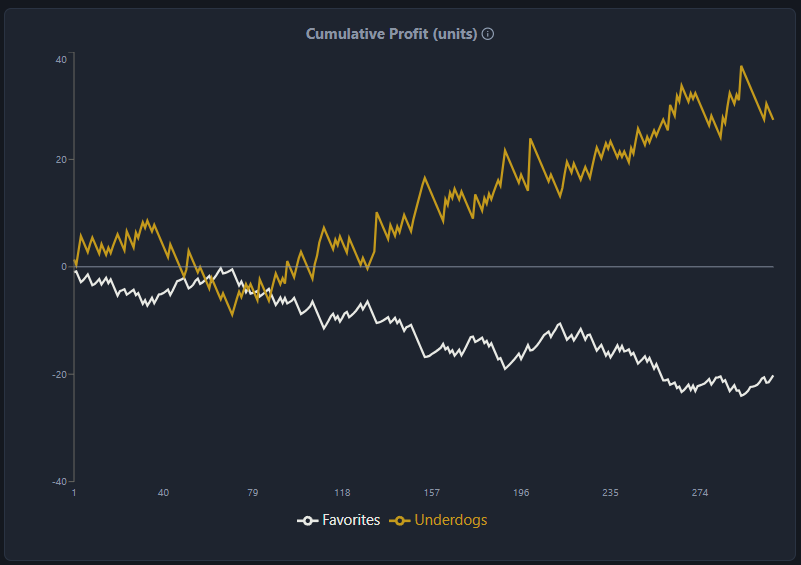
The Pre-US Open Masters 1000s
Now let’s combine Cincinnati with the Canadian Masters 1000 — the two Masters 1000 events played in the build-up to the US Open. The Canadian Masters 1000 alternates between Montreal and Toronto.
This is where the pattern becomes even more interesting.
Overall, across 1,763 matches, underdogs have outperformed favorites by 12 percentage points of ROI:
- Underdogs: +5.8%
- Favorites: -6.2%
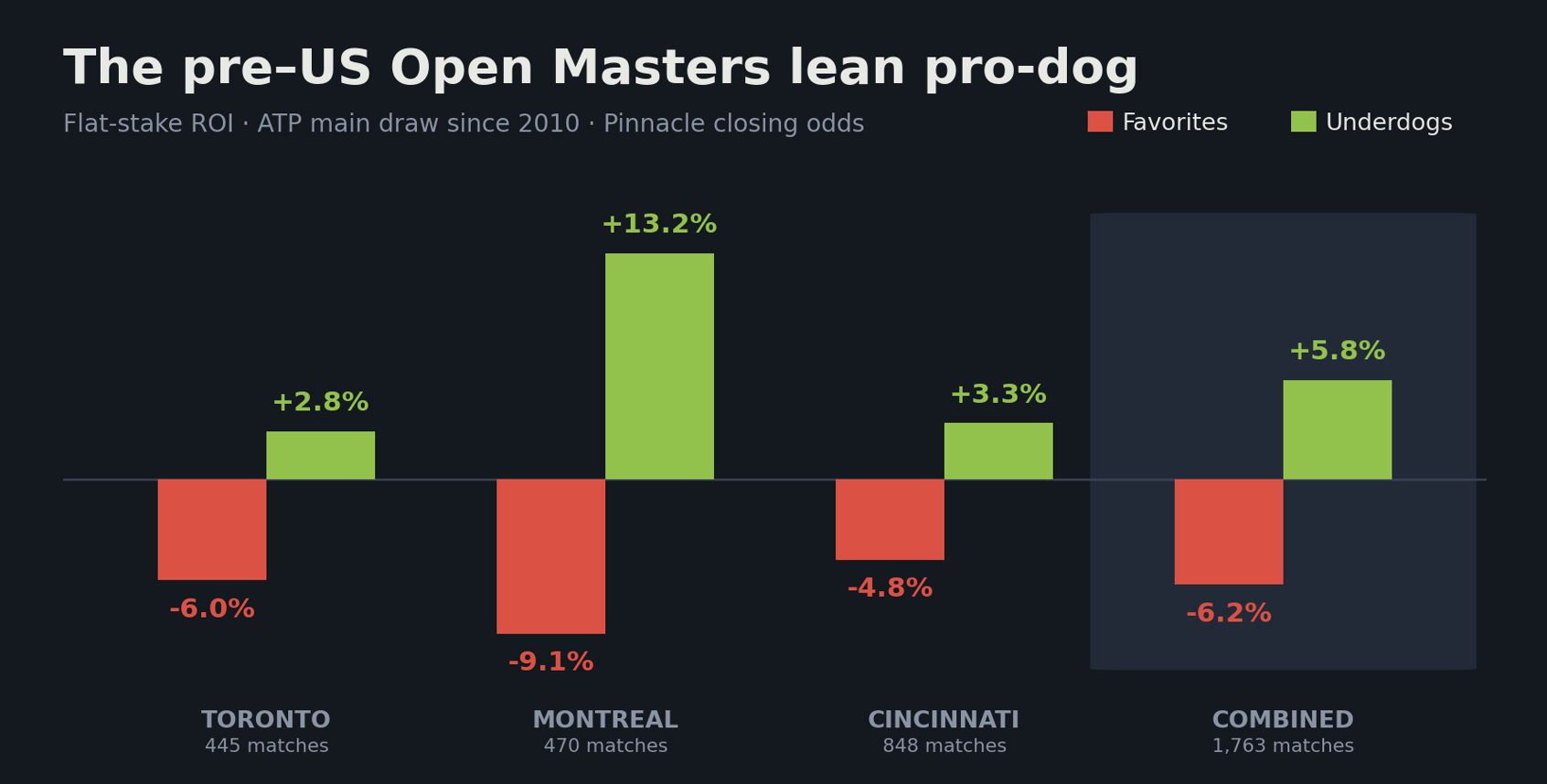
That is a substantial gap, particularly considering that the favorite-longshot bias would normally push the expected difference in the opposite direction.
In other words, the historical data suggest that the two Masters 1000s leading into the US Open have been unusually favorable to underdogs relative to favorites.
Will the same thing happen again in Cincinnati this year?
Obviously, we don’t know.
The pattern did continue in Montreal 2026. Across 95 matches:
- Underdogs: +4.1%
- Favorites: -4.2%
Of course, 95 matches is a very small sample, so I wouldn’t draw any strong conclusions from this edition alone. But it is consistent with the much larger historical pattern.
Explore the Data on FavOrDog
All these numbers come from the app I have developed FavOrDog, where I update the database weekly.
You can analyze betting performance by individual tournament, tournament category (Grand Slams, Masters 1000s, ATP 500s and ATP 250s), round and odds range, among other filters.
I also recently added a new Players section, where you can see the historical betting performance of backing or fading every ATP player in the database with at least 10 matches played.
Access to FavOrDog costs €300 per year, although you can also get access for free.
More info: favordog.io


