

Rio's ATP 500 Heat Burns Favorites
Favorites have been a losing bet in Rio since 2010. The data shows a statistically significant gap with underdogs — and the brutal playing conditions might explain why.

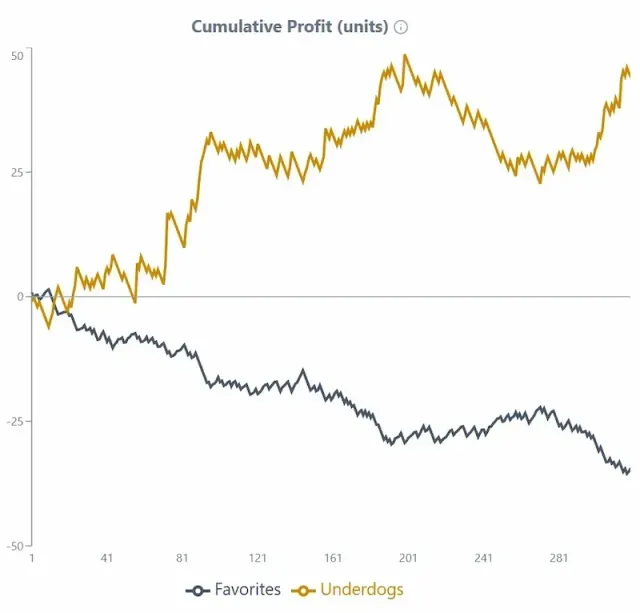
In my preview of the ATP 500 in Rio de Janeiro, I noted that — as many players have pointed out — the heat and humidity are so extreme that they take a real toll on the body.
The air is heavy, the humidity is extreme, and the ball gets bigger and heavier. Rallies get longer, and the conditions wear players down physically in a way few other tournaments do.
With that in mind, I looked at the historical performance of underdogs and favorites to see if the data reflected something unusual — and this is what I found.
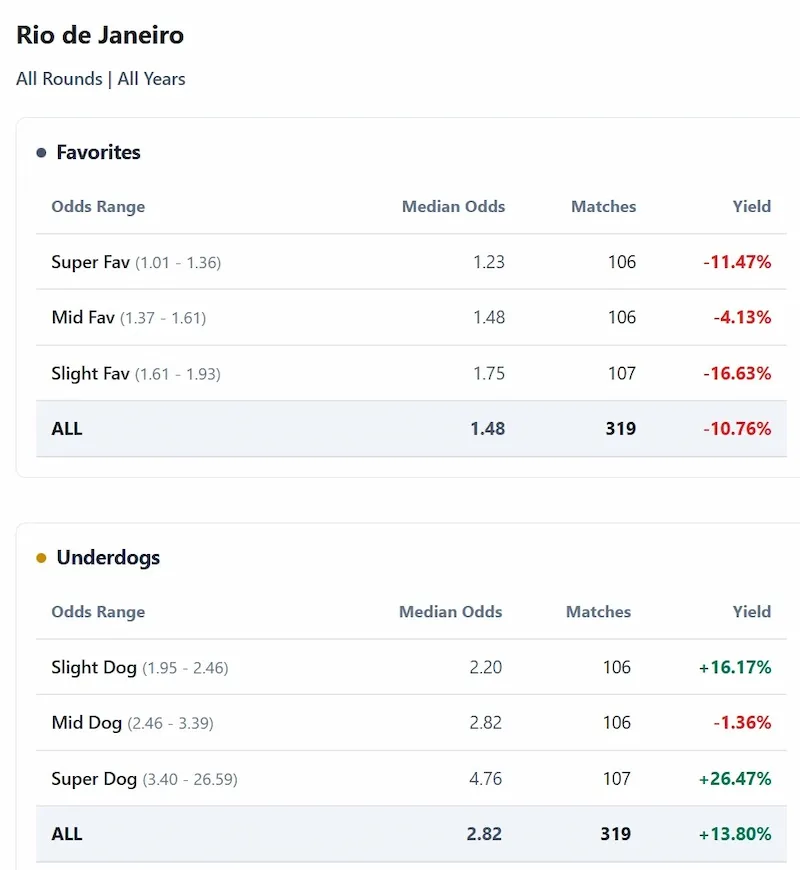
As you can also see in the chart above, the yield for favorites since 2010 sits at -10.76%, while underdogs have returned +13.8%.
With 319 valid matches/bets, the sample is not large enough to confidently claim that backing underdogs in Rio will produce a positive return on its own. However, what we can say with statistical confidence is that the gap between the two groups (24.5+ points) is significant: underdogs outperform favorites in Rio, and favorites perform particularly poorly. The edge may not be underdogs being great — it's favorites being terrible.
So a first takeaway: be cautious with favorites in Rio — they are very likely to deliver a negative expected return in the long run. As for underdogs, we can't guarantee they're profitable, but unlike most tournaments where backing underdogs is a clear losing strategy, in Rio they are at least knocking on the door of positive EV.
On the other hand, when we combine this quantitative evidence with what we know about Rio's notoriously tough playing conditions, a pattern starts to emerge. Extreme heat and humidity tend to level the playing field — when conditions are brutal, the gap between a favorite and an underdog shrinks, and the probability of an upset rises. This could very well be the driving force behind the numbers above.
Although we can't state it categorically, it's a hypothesis I find highly credible.
Lastly, you might wonder why we can confidently say that favorites perform poorly in Rio but can't guarantee that underdogs are profitable. Well, it all comes down to the higher odds of underdogs and the variance that comes with them.
But I'll explain this in a separate article.


