

Paris 2026 - Masters 1000 Preview
(2 - 8 November) The Paris Masters courts have been resurfaced to play faster in 2026. My preview examines the tournament director’s comments, the switch to Dunlop balls and the latest qualifying statistics.

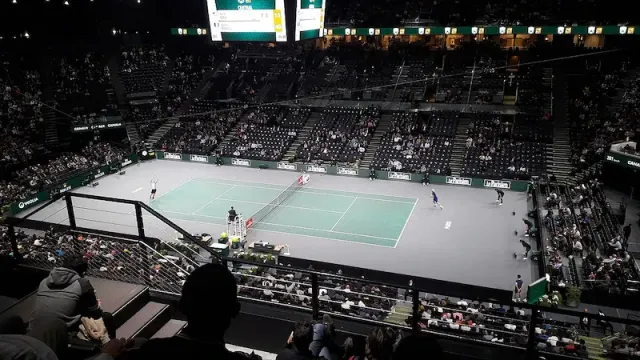
This is my preview of the last Masters 1000 of the season, the Rolex Paris Masters.
The tournament moved to a new venue last season, bringing a clear change in playing conditions. The players’ feedback and the data both pointed to slower courts than in 2024.
For 2026, however, the organisers have announced another adjustment, this time to increase the pace. That makes it important to distinguish last year’s conditions from what we can expect this week.
Tournament Director's Comments
Here’s what Cédric Pioline, the tournament director, said about the decision to slow the courts down in 2025:
“We wanted to slow the court down because we were told last year’s surface was too fast. Total consensus is impossible, but we tried to reach the broadest possible agreement.”
These are the percentages of first-serve points won in the main draw over the past five editions:
2021: 71.2%
2022: 73.4%
2023: 73.4%
2024: 76.2%
2025: 73.8%
The drop in 2025 is consistent with Pioline’s explanation, although the percentage remained close to those recorded in 2022 and 2023. On this measure, 2024 looks like the exceptional year. These figures also depend on the players and matchups, so they should not be treated as a direct measurement of court speed.
For 2026, Pioline says the courts have been made noticeably faster:
“The surface is faster this year than last year, and quite noticeably so. There can sometimes be a slightly subjective element to how it feels, but there is also feedback, in connection with the ATP, through the players. Without going into details, we were a bit surprised by how slow it was last year, so we asked for it to be sped up, and the players seem happy.”
He also explained the target pace:
“Finding the right balance is very tricky. We tried to get close to the conditions in Turin, for the players who will be involved there. We should be around 40 [CPI], at least that's what we asked for.”
I have also calculated the qualifying figures: 73.2% in 2026, matching 2025. That compares with 75.2% in 2023 and 74.5% in 2024. So far, the serving numbers do not show a clear increase over last year, but a single qualifying weekend is too small a sample to settle the question.
CPI (Court Pace Index)
These are the readings for Paris through 2025:
2025: 35.1
2024: 45.5
2023: 40.4
2022: 37.1
2021: 37.1
The balls
The surface was not the only talking point last season. There were also complaints about the balls, particularly their consistency. This is what Auger-Aliassime said after beating Comesana:
"Frankly, the balls are rubbish, they don't bounce straight! When you try to put the ball in the court, it's fine, but as soon as you try to be precise with your serve or hit, it’s a problem. This has to change. We have to find a solution; we've been talking about it since Covid, but each time, there is no solution. We have to find one to make things better. If you look at the ball you play in tennis, there's always a white seam. Here, the seam is not uniform, so sometimes it's wider, sometimes it's thinner, sometimes there's a hollow. The ball is not really round. The last two weeks in Basel and Brussels, the balls were normal. When you play tennis every day of your life, there's a real difference, it's monumental."
Munar also said "The balls feels like a beach ball".
Norrie offered a more positive assessment: "This suits my game well; the ball bounces a little harder than I remember. It's always been quite low here, so it's very good for my forehand; I can get a lot of rotation on it.·
These comments suggest that the ball’s consistency and bounce were important parts of how players experienced the conditions.
There is a relevant change for this edition: Paris is using Dunlop balls in 2026, as part of the ATP’s move towards consistent balls across the autumn swing.
Past winners
2025: Sinner d. Auger-Aliassime
2024: Zverev d. Humbert
2023: Djokovic d. Dimitrov
2022: Rune d. Djokovic
2021: Djokovic d. Medvedev
Players' quotes
All the following quotes are from 2025.
Bublik: "This is the slowest indoor hard court I've ever played. By a huge margin. Last year, the court was incredibly fast, like a short track."
Zverev: "I don't want to sound like I'm complaining every week, but I think the surface here is pretty weird. It's really slow, and the ball bounces really low. It's hard to hit good shots. Even if you hit a powerful, accurate shot, it feels like it's not rewarded. If you hit it hard with spin, the ball stays low, and if you just hit it hard, it loses speed. I don't think the best players are hitting as effectively here. That might be the reason. We'll see how the tournament goes. Maybe, over time, the favorites will start winning, and everything I've said will be pointless."
Rublev: "Court One is a little different from the Centre Court; it's a bit faster, but overall it's good. I didn't hear any noise at all."
Ben Shelton: “I think it’s a bit slower than in years past and I like it a lot. Slow indoor courts where it’s controlled but you can still serve well is a great court for me. It makes for exciting tennis as well. I’ve only heard good things from the players. It seems to be pretty consistent in terms of court speed between the courts. I’m excited to be in this new venue. They’ve done a great job and made a lot of improvements so I’m happy to see that progress.”
Flavio Cobolli: “I can say that the court is fast, but not too fast. You can play real tennis. There are tournaments with surfaces that are far too fast, which only favor certain types of players. Here, however, you can build, you can vary; for me, it's ideal.”
Cameron Norrie: “Last year, everything was really fast, and I couldn't hit as many shots. This suits my game well; the ball bounces a little harder than I remember. It's always been quite low here, so it's very good for my forehand; I can get a lot of rotation on it.”
Alexander Bublik: “The courts are slow, the ceilings are high, there's a lot of space, so it's a completely strange feeling on court.”
Terence Atmane: “There are some great rallies, and it leaves chances to come back if you're a break behind. Not too slow, but slow enough.”
Andrey Rublev: “I don't know, I'd have to play a match to understand, because when I was training, they weren't particularly slow for me. They're still a bit fast for me, but until you play a match, you won't really understand, because when you're pumped up with adrenaline, nerves, and so on, everything feels completely different. From the outside, it seems slow, but when you start playing, it's not so slow.”
Summary
Paris was substantially slower in 2025 than in the unusually quick 2024 edition. Even so, the lower pace did not prevent strong servers and accomplished hard-court players from going deep.
Last year’s eight quarterfinalists were Vacherot, Auger-Aliassime, Bublik, De Minaur, Medvedev, Zverev, Shelton and Sinner, all players who get their best results on quick courts.
For 2026, my working expectation is a quicker tournament than in 2025, without necessarily returning to the extreme pace of 2024. That follows the organisers’ stated intention, while the qualifying figures remain almost unchanged. I’ll be watching the opening main-draw matches closely to see how the adjusted surface and new balls translate into match conditions.
Draws
You can follow the latest draw updates here:
- Main draw: https://www.protennislive.com/posting/2026/352/mds.pdf
- Qualifying Draw: https://www.protennislive.com/posting/2026/352/qs.pdf