

Underdogs vs Favorites in Masters 1000 Hard Courts: What 16 Years of Data Show
6,000+ bets. 16 years. Underdogs have clearly outperformed Favorites at Pinnacle closing odds in Masters 1000 hard courts. Full analysis here.


Today I want to share a very interesting stat on underdogs and favorites in Masters 1000 events played on hard courts — both outdoor and indoor.
At some point I'll give you the reasons why I think clay has historically been a very hostile surface for underdogs, which is why I've excluded it from this analysis.
The Dataset: 6,000+ Bets at Pinnacle Closing Odds (2010–2025)
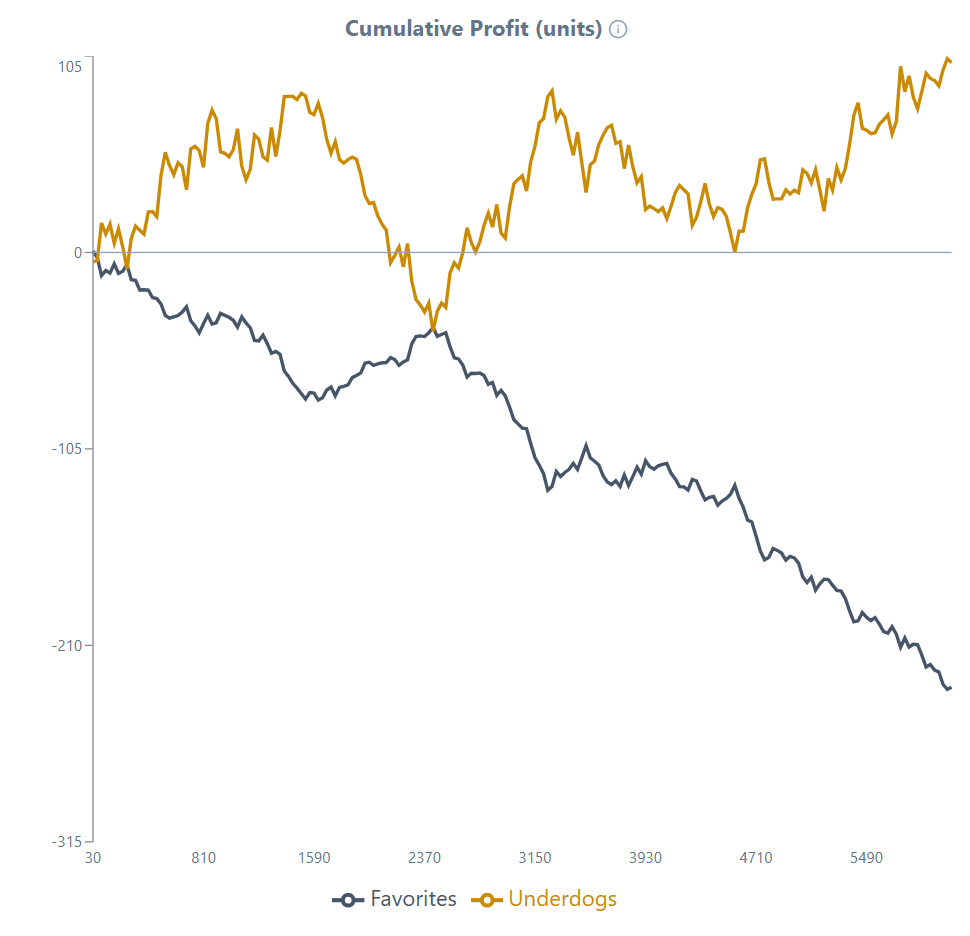
This is a large sample of more than 6,000 bets, from 2010 to 2025. And yes, blindly backing underdogs at Pinnacle closing odds would have produced a +1.7% yield, while doing the same with favorites would have resulted in a -3.8% yield.
If clay-court Masters 1000 events are included, the bias still exists — but it becomes only a bit less pronounced.
Breaking Down the Results: Slight, Mid and Big Underdogs
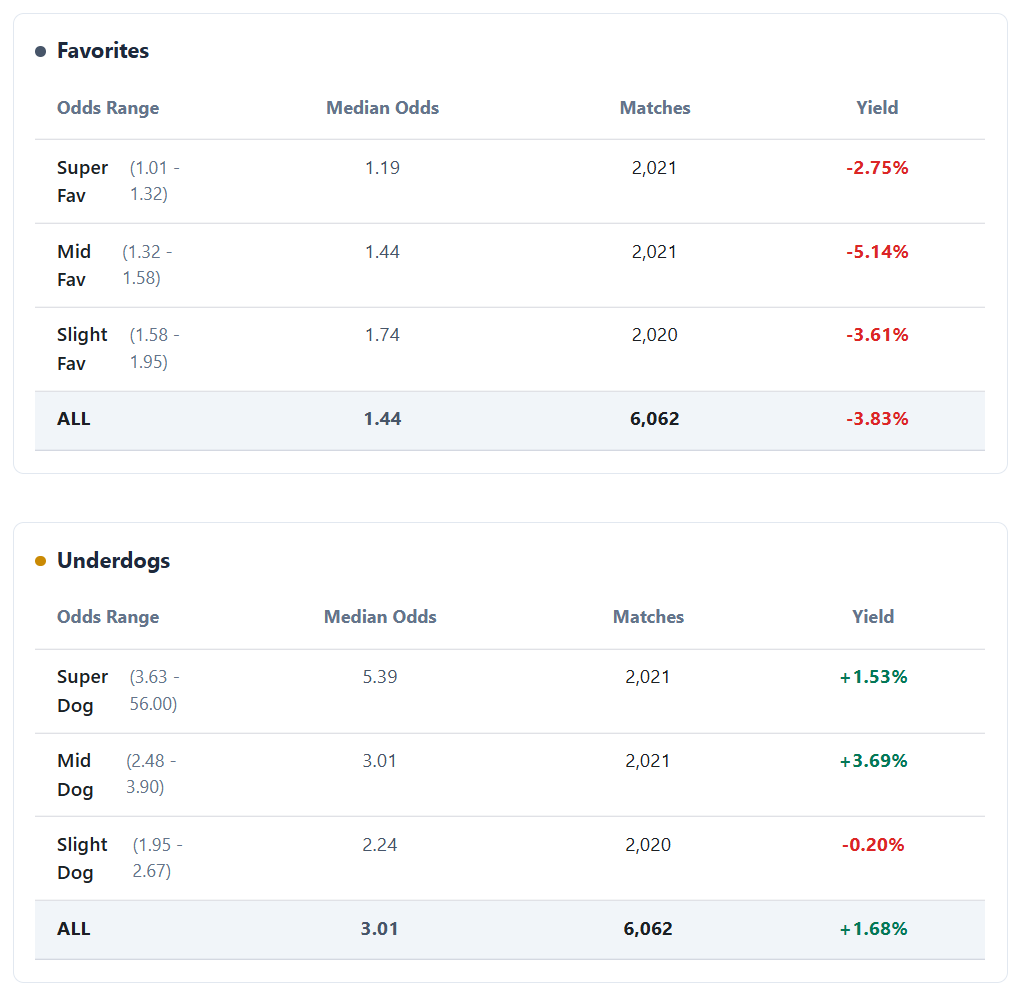
I’m also attaching a table with the results split into three equal groups, from bigger to smaller underdogs and from bigger to smaller favorites.
What we can see is that in the slight underdog range, performance is almost flat, while in the mid underdog and big underdog ranges, it is positive.
By contrast, favorites show negative performance in all three ranges.
What This Proves — and What It Doesn't
Does this mean you should blindly bet underdogs in non-clay Masters 1000 events? No.
A +1.7% yield, even over more than 6,000 bets, does not statistically prove that this is a profitable strategy. Underdogs carry much more inherent volatility, which means a far larger sample is needed to reach statistical significance.
On the favorites side, however, we can say that betting on them is surely a losing strategy and this is statistically significant. With favorites, there aren't a few big prices that can heavily distort the results, so the average odds are much lower (1.44 in this case).
What this does suggest, in my view, is that there is a long-term bias in favour of underdogs and against favorites in relative terms in these events.
That said, this is still a long-term tendency, not a rule, and we cannot be sure that history will repeat itself going forward. It is simply one more element to add to your betting framework.
This is one of the reasons why I tend to be more pro-underdog in Masters 1000 events than in Grand Slams.
And I repeat, this is very much a long-term effect. Just look around bet number 1,590 in the chart, where underdogs went through a stretch of something less than 1,000 bets with very poor results.
It is also worth noting that this is not just true for the full sample since 2010. The results are also more favourable to underdogs and more negative for favorites over the last 10 years, last 5 years, and last 3 years.
Why Does This Bias Exist?
So why might this happen? Is it just variance?
My hypothesis is that bettors may place too much weight on the fact that these are Masters 1000 events. Because they are seen as such important tournaments, the market may assume that the top players are especially motivated, fully focused, and far less likely to lose than they would be in lower-level events. That, in turn, can lead to favorites being priced shorter than they should be.
The problem is that these are still best-of-three-set matches, not Grand Slams. And in that format, upsets are naturally more frequent than many bettors seem to expect. So if the market is overestimating the protection that “importance” gives to the better player, that could help explain why favorites have performed so poorly, and why underdogs have done relatively much better.
Of course, this is only a theory — I’m not claiming to have the answer. But after so many thousands of bets, I find it hard to believe that a pattern like this has no real explanation behind it.


