

Indian Wells: Where Underdogs Consistently Outperform Favorites
Indian Wells has historically been one of the worst tournaments for betting favorites. Here we break down the numbers — and ask whether this reflects a systematic market inefficiency.

So far, 46 main-draw matches have been played at Indian Wells 2026. Favorites are performing very well for now. They have won 34 matches, while underdogs have managed just 12 victories. ROI on favorites: +12.4% ROI on underdogs: -35.8%.
A Slow Start for Underdogs — But History Suggests That May Change
However, this has not been the typical historical pattern at Indian Wells. In fact, Indian Wells is one of the tournaments where favorites have tended to perform relatively poorly, while underdogs have done much better than usual.
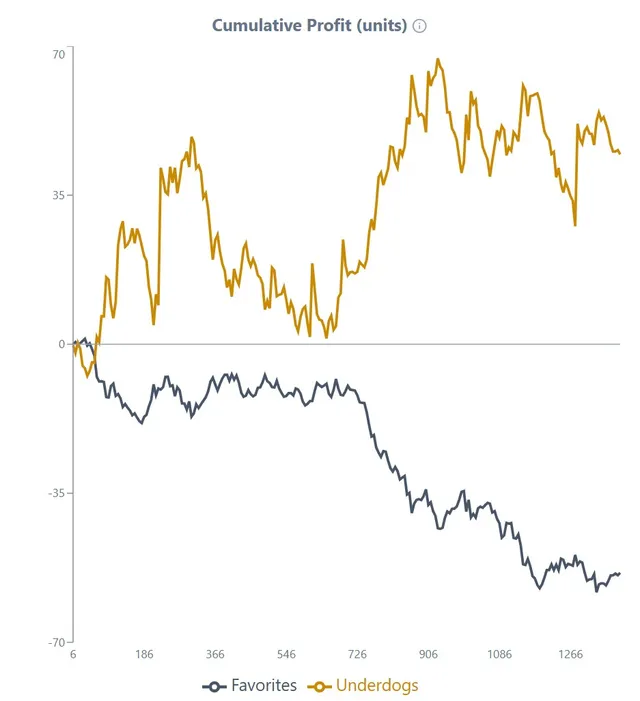
Indian Wells: Where Underdogs Consistently Outperform Favorites
Since 2010, favorites have posted a -3.9% yield, while underdogs have delivered a +3.2% ROI.
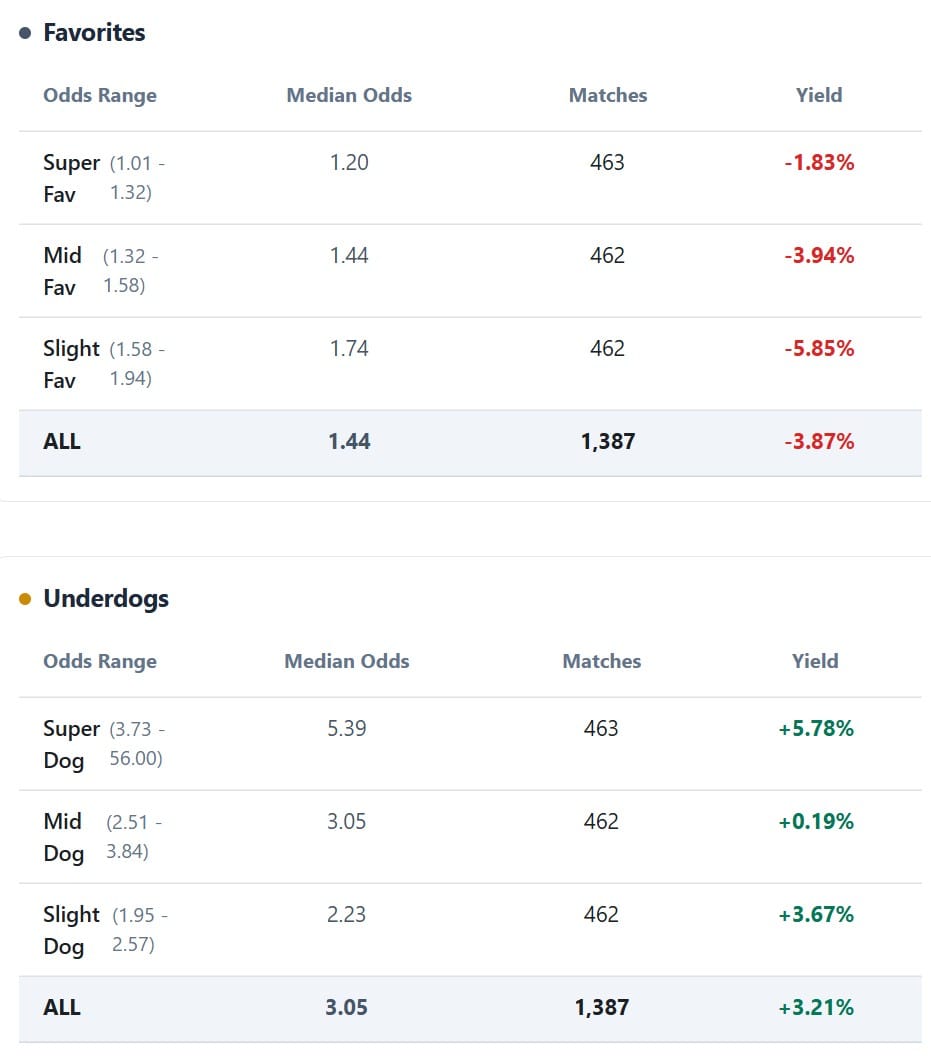
And here you can see the same data split into three groups with an equal number of bets.
(1-unit flat stakes at Pinnacle closing odds have been used for the analysis.)
A Systematic Market Inefficiency?
So why might this happen? Is it just variance? Just noise? Or could it be that favorites are systematically overpriced at Indian Wells?
The market may never fully adjust to just how slow these courts have traditionally played, creating conditions in which clay-court underdogs can outperform expectations.
Of course, most sharp bettors know that Indian Wells has historically been played in very slow conditions. But perhaps the market has still not adjusted prices enough. We'll see how things evolve.
What the Data Actually Tells Us — And What It Doesn't
In summary, the sample size of this analysis (1,387 matches) and the ROI gap between favorites and underdogs are large enough to conclude that there is a systematic bias against favorites at this tournament.
This does not mean that betting underdogs is +EV in the long run. On the underdog side, a handful of high-odds bets can move the needle significantly. There is more implied volatility, and therefore we need a larger sample — or a considerably higher ROI — before drawing firm conclusions.
With favorites, however, the picture is different. A few bets cannot distort the results, and there is less volatility embedded in the prices. The results are therefore more statistically meaningful. Based on the available data, we can say that there has been a clearly negative bias against favorites at Indian Wells.
As for 2026 and again this trend, favorites are off to a strong start in the early rounds. We will see how things develop from here.


