

FavOrDog Review: Why I Built It — And How You Get 12 Months Free
FavOrDog is my own tennis betting analytics tool — 41,000+ ATP matches since 2010, Pinnacle closing odds. Why I built it, how I use it, andhow you can access it Free.


When it comes to betting on tennis, most serious bettors do their homework. They check stats, they read up on player fitness, they look at head-to-head records, they study the tournament, the surface, the conditions. All of that matters.
But there's one variable even experienced bettors rarely look at: how favorites and underdogs have historically performed in that specific context — this tournament, this surface, this round, this odds range, this player. Because sometimes the market has biases. Sometimes large ones. Sometimes persistent ones.
Did you know that if you had blindly bet on favorites at Roland Garros since 2010, you would have made money? And that if you had done the same with underdogs, you would have lost around 18%?
That's the kind of pattern I'm talking about. It's not intuition. It's not a system. It's just what the data shows — and most tennis bettors never look at it.
So I have built FavOrDog — a tool that lets you check this exact kind of thing against 16+ years of real ATP data, with Pinnacle closing odds, across 40,000+ matches. So below I want to tell you what it is, how and why I use it, and why I think serious tennis bettors should use it too.
What FavOrDog Actually Does
At its core, FavOrDog answers one question: how have favorites and underdogs historically performed in a given context?
And it lets you ask that question at three levels of zoom — from the entire tour, down to a single tournament, down to a single player. The whole circuit, one event, or one name. Same data, three ways to look at it.
That context can be a single tournament — say, the Rome Masters 1000 — or a broader filter across the entire ATP circuit. You can slice the data by tournament type, surface, round, year range, and odds range. Every number you see is based on real matches, real results, and closing odds from Pinnacle.
Why Pinnacle closing odds? Because they're the sharpest odds available. The closing line at Pinnacle is widely considered the best proxy for true probability in tennis. That's the benchmark.
A quick note on scope: FavOrDog currently covers ATP only for now (WTA version coming later), main draw, data from 2010 onwards, 500+ player profiles, no data export, and the interface is desktop-first.
The Most Important Thing to Understand: The Baseline
Before you open FavOrDog and start looking at numbers, there's one thing you need to understand or you'll misread everything you see.
The baseline for blind betting on ATP tennis since 2010 is roughly -2% ROI on favorites and -5.6% ROI on underdogs — at Pinnacle odds.
Why this matters: if you see a tournament where favorites and underdogs have both returned around -1.5%, it means that, in relative terms, the underdogs are doing quite well. They're performing four percentage points better than their baseline. That's a pro-dog signal, even though the ROI is technically negative.
Why are dogs structurally worse? Because of the favorite-longshot bias — bookmakers systematically price underdogs with higher margins, especially extreme underdogs. This isn't a Pinnacle-specific thing; it's how the betting market works. The higher the odds, the worse the deal for the bettor. So the -6% baseline for dogs is built into the math of the sport's betting market.
Keep this in mind as you read any numbers in the tool. Everything is relative to these baselines, not to zero.
The Three Main Modes
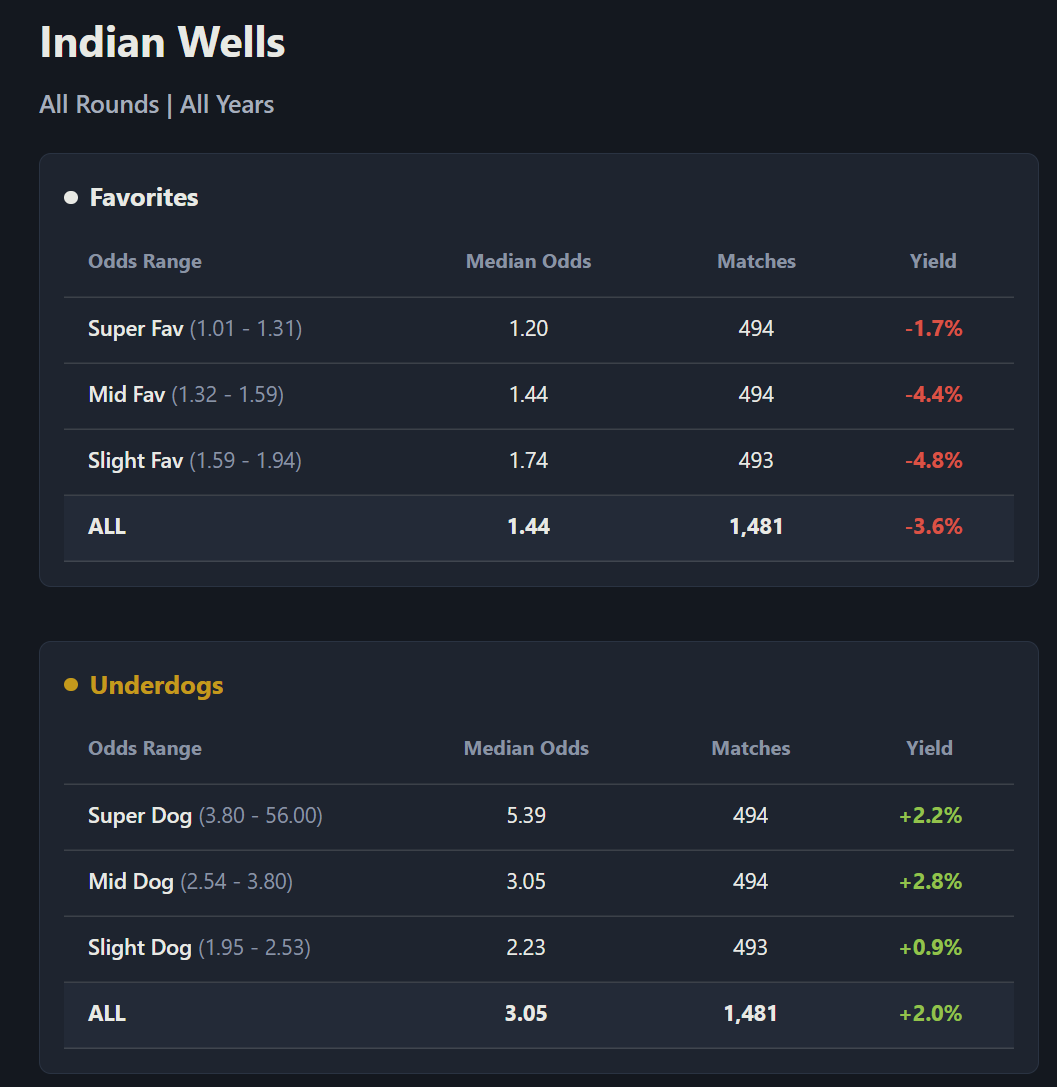
Before describing each mode, it's worth explaining what you'll actually see. Every filter you apply in FavOrDog returns the same kind of output: tables with odds terciles (one for favorites, one for underdogs) showing ROI and match counts for each third of the odds range, plus a cumulative profit chart over time. That consistency means once you know how to read one view, you know how to read them all.
Here's the table. You'll see the chart in another example further down.
FavOrDog has three ways of exploring the data, from wide to narrow. Each one is useful for a different purpose.
By Tournament
This is the mode I use most during the season. A tournament starts on Monday, I open FavOrDog, search for it, and I immediately see its historical profile — overall ROI for favorites and underdogs, broken down by odds tercile (heavy favorites, mid, slight), with a cumulative profit chart going back to 2010.
From there I can drill down: last season, last 3, 5, 10... years only, specific rounds, specific odds ranges. It gives me a quick read on whether this tournament has historically favored one side or the other, and where within the odds range the value has been.
By Tour (Aggregate)
This is where you go when you want to look at the big picture across the entire circuit.
The Summary tab gives you pre-built breakdowns by tournament type (Grand Slams, Masters 1000, ATP500, ATP250), surface (clay, hard outdoor, hard indoor, grass), round, and time period. It's the fastest way to spot structural patterns across all of tennis.
The Custom tab lets you build your own filter. Want to see only hard court first rounds in ATP250s over the last 5 years, restricted to underdogs between 2.00 and 3.00? You can do that. Any combination of filters, any time range. The data updates weekly during the season.
By Player
This is the newest mode, and the one that surprises people the most.
Pick any of 500+ ATP players and you see their full betting profile: their ROI overall, their ROI as a favorite, and their ROI as an underdog — each with its own cumulative profit chart going back to 2010. Because here's the thing most people miss: the same player is often two completely different bets depending on which side of the line he walks onto court.
Take Alexander Bublik. Backing him in every main-draw match has actually turned a profit: +12.3% ROI. But look underneath:
- As a favorite: -2.1% ROI
- As an underdog: +25.6% ROI
When he's expected to win, he quietly bleeds. When he's written off, he's been one of the most profitable dogs on tour — he wins less than half his underdog matches, but when he does, the odds are big enough to more than make up for it. The market has never quite known how to price him.
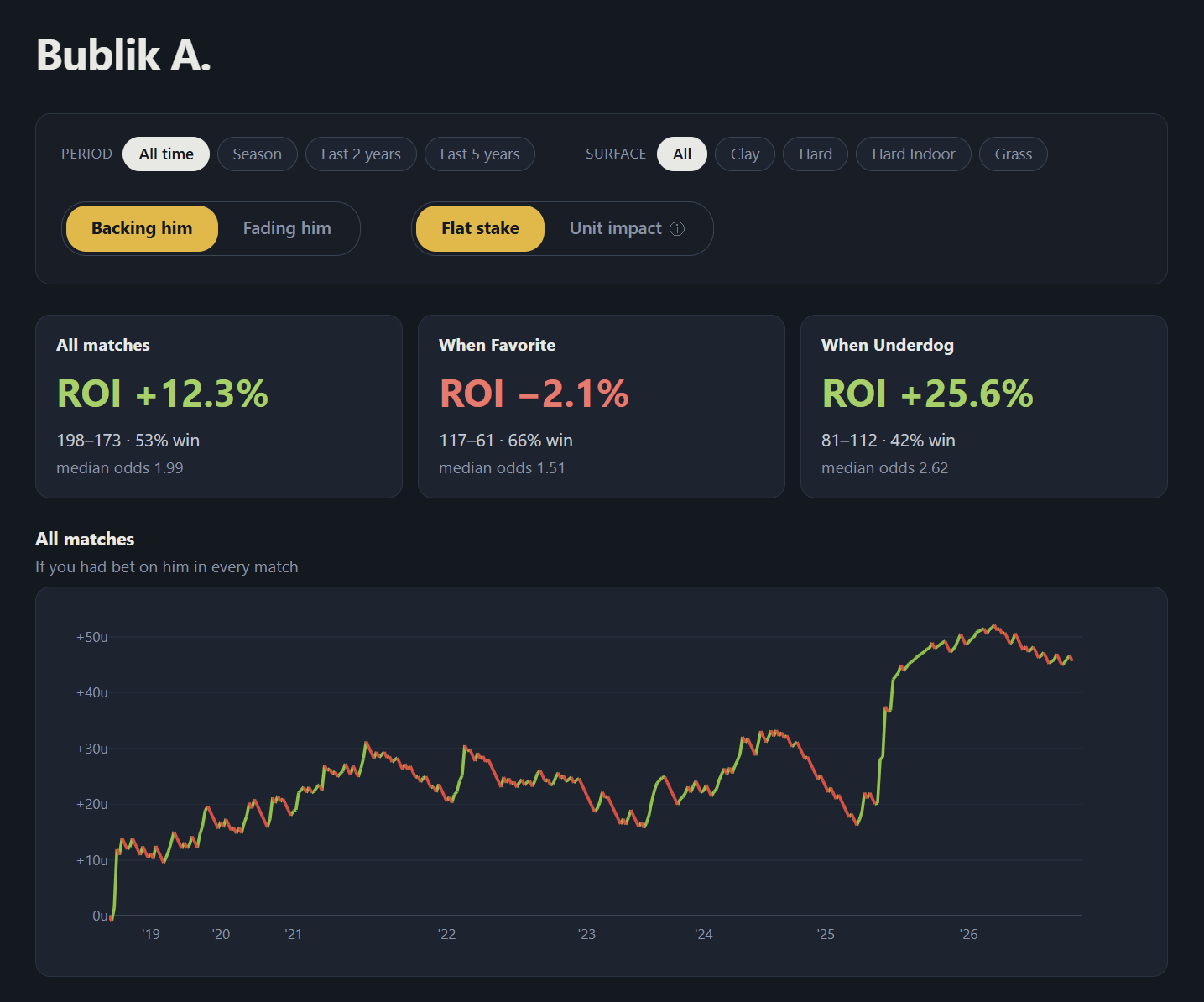
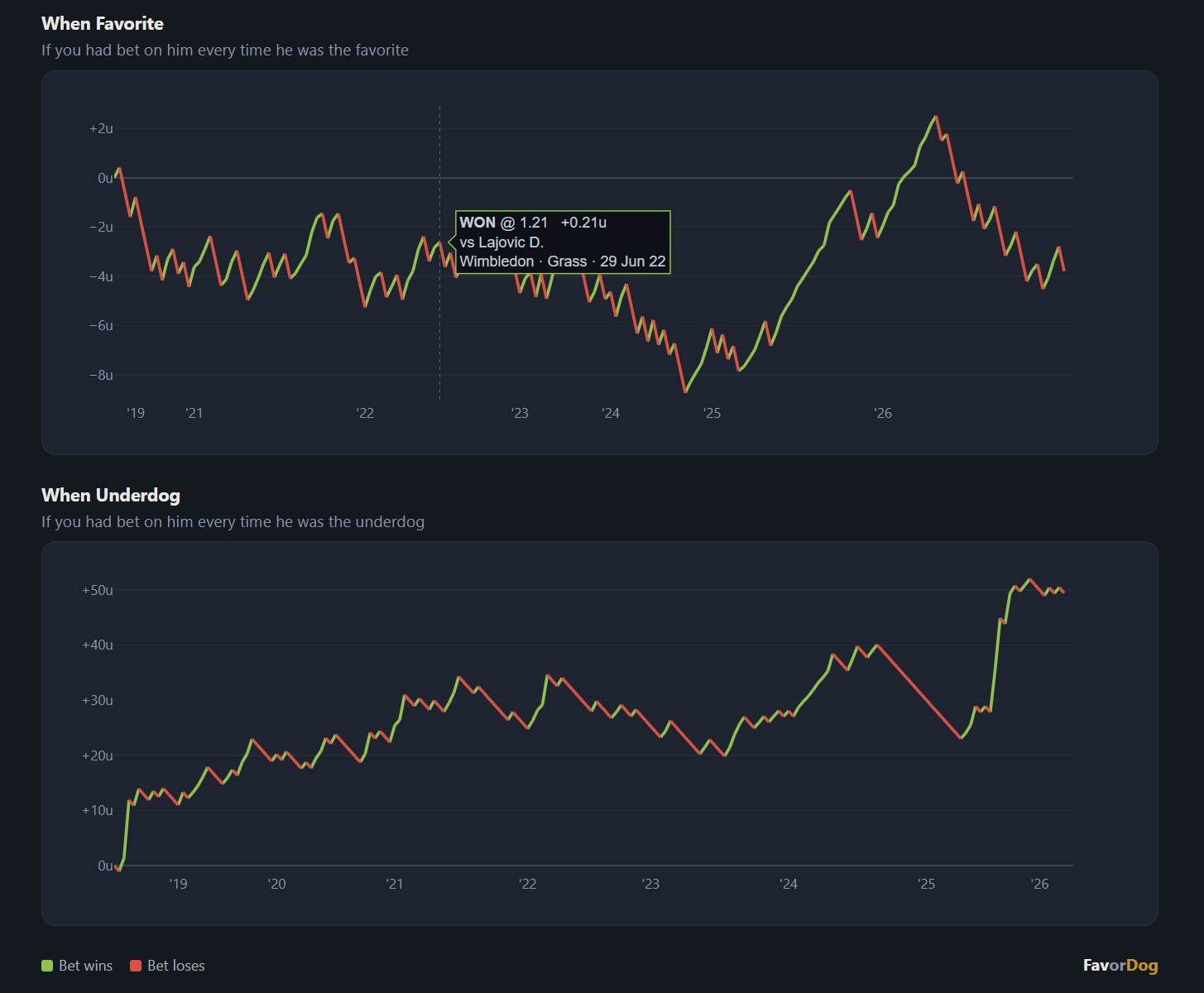
One more thing specific to the Players section: you can view every profile under two staking methods. Flat stake is one unit on every match — simple, but it lets a couple of lucky longshots inflate a player's ROI. Unit impact sizes each bet so the gap between winning and losing is always exactly 1u: at odds 2.00 you stake 0.50u, at 1.50 you stake 0.67u, at 5.00 just 0.20u. Every match moves the bankroll by the same amount, which is closer to how bettors really stake — it's the method introduced in a 2019 academic paper. If a pattern survives both methods, it's more likely to be real. It's a robustness check, not a betting system.
Some players are steady and efficient. Others, like Bublik, are a completely different bet depending on the situation. Finding those splits is where it gets interesting.
A Few Examples of What the Data Shows
Roland Garros is a good example.
Since 2010, backing favorites at Pinnacle closing odds would have produced a small positive return: +1.2% ROI. Backing underdogs, however, would have been a disaster: -17.9% ROI across 2,127 bets.
That does not mean the same pattern will repeat in the future. Past performance never guarantees anything.
But this is exactly the kind of thing FavOrDog is built to uncover: long-term betting patterns by tournament, surface, round, odds range, and market side.
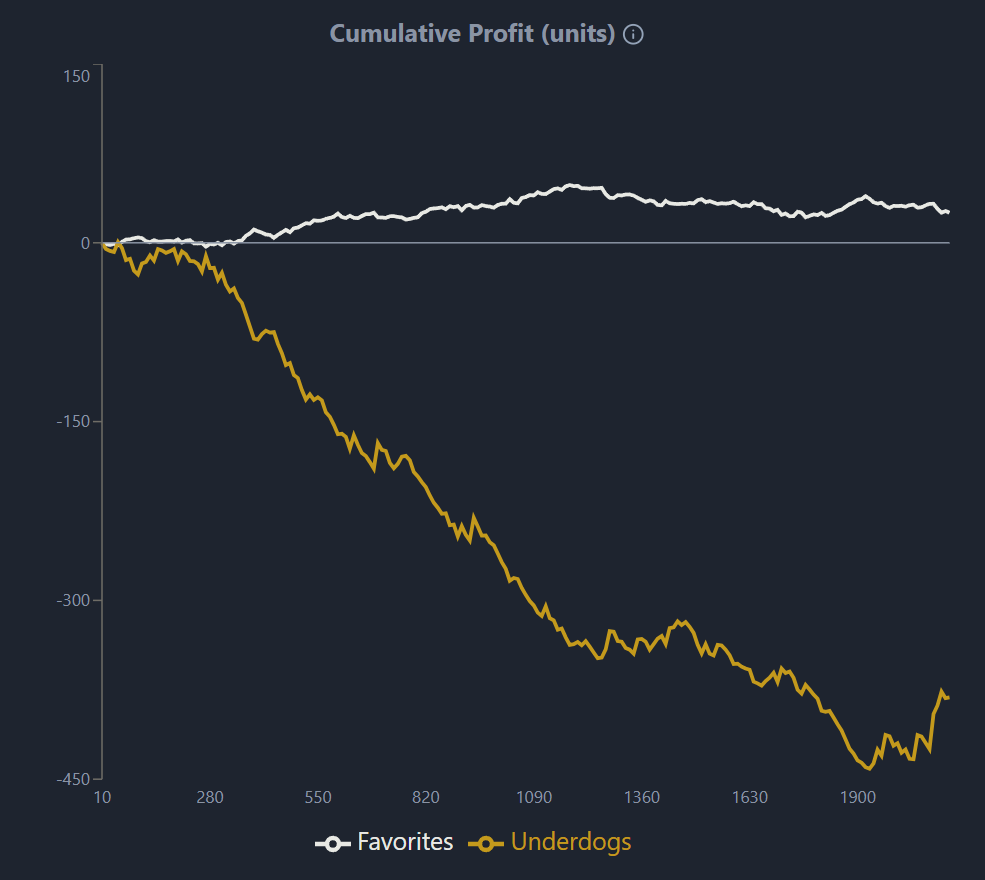
Masters 1000 hard court tournaments show a very different pattern. Over the last decade, underdogs have delivered positive returns (ROI +2.6%) while favorites have been negative (ROI -4.1%). That's unusual and persistent enough to be worth paying attention to.
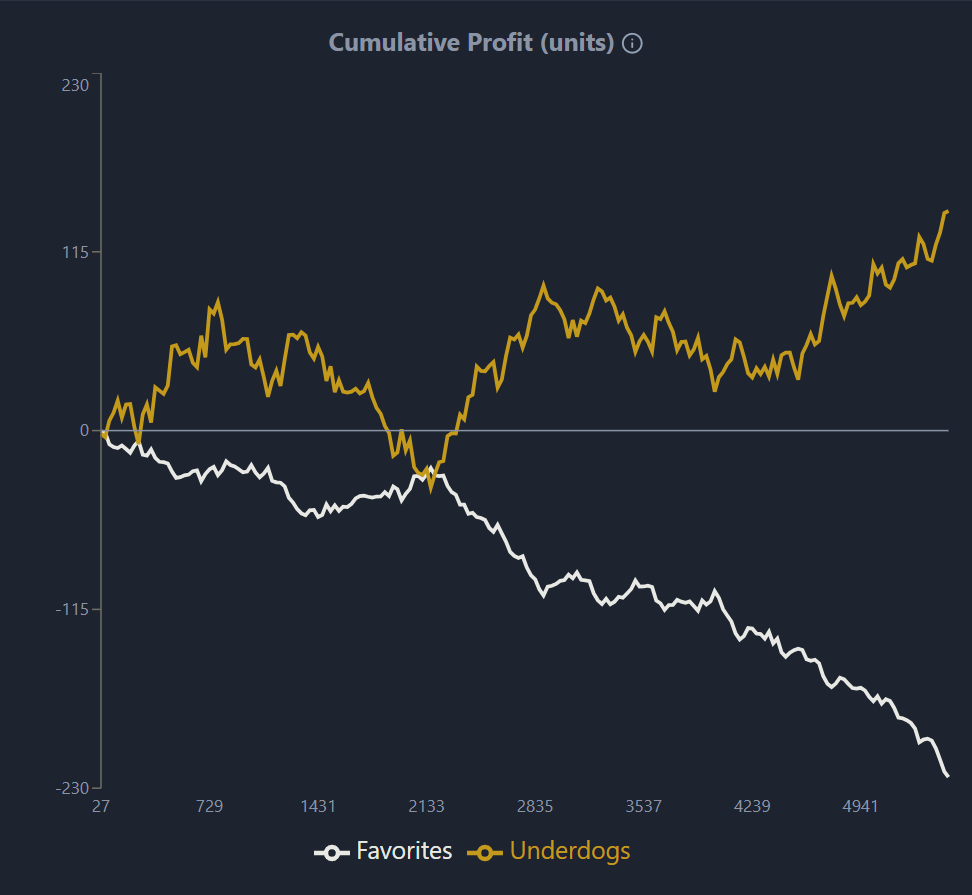
These aren't secrets. There are many more like them across the circuit, and you'll find the ones that matter to your betting once you start exploring the tool.
What FavOrDog Is NOT
This is important. I don't want anyone signing up with the wrong expectations.
FavOrDog is not a tipster service. It doesn't tell you what to bet tomorrow. It doesn't predict matches. It doesn't give you "today's pick."
It's not a system. Blindly following historical ROI numbers is a fast way to lose money. Markets change. Samples contain variance. Context matters.
It's not a replacement for your own analysis. Player form, head-to-head, conditions, motivation, recent travel, injuries — all of that still matters. FavOrDog doesn't know any of it.
What it IS is one more piece of information for the most serious bettors. An analytical input you can combine with everything else you already do. It tells you what the historical context looks like before you make your call. That's it. For me, that's been valuable enough to build the whole thing.
How Much It Costs and How to Get In
There are two ways to access FavOrDog.
Paid access: €300 for 12 months. One-time payment, no auto-renewal. Full access to all filters, all charts, all data. Weekly updates during the season.
Free access via partner betting broker/bookmaker. Register at the broker BetInAsia (minimum €50 deposit) or the bookmaker Bet105 (minimum $100 deposit) through my links, and you get 12 months of FavOrDog for free. At BetInAsia you also get my exclusive 0.11% lifetime cashback on every bet — use code CBNISHI when registering. At Bet105, use code NISHI for an exclusive 0.50% weekly rebate in free play. Either way, this path pays you, not the other way around.
If you're not familiar with either option, you can read my detailed reviews of BetInAsia and Bet105 before signing up.
How I Actually Use It
Here's the mindset I use, and I'd recommend the same for anyone signing up.
I pay attention when I see clear biases over large samples. Not small differences — clear ones. A 2% gap between underdogs and favorites over 150 matches is noise. A gap of 8 percentage points over 900 matches is something else entirely. You have to be honest with yourself about which one you're looking at. A big part of what you see in the data is pure variance, and tennis has a lot of randomness built in. If I filter down to something like "second round at Båstad, favorite odds between 1.40 and 1.60, last 3 years," I might get 18 matches. Whatever ROI that shows tells me nothing.
But when I do see a clear bias on a meaningful sample, I adjust how I bet accordingly. A couple of concrete examples from my own betting:
I'm a bettor who tends to back underdogs more than favorites. But at Roland Garros, where the data shows dogs have been a disaster for 16+ years, I'm much more selective. I don't stop betting dogs completely — but I'm a lot tighter. I need to see much stronger reasons to pull the trigger than I would at another tournament.
The opposite happens at Masters 1000 events. The data shows underdogs have done relatively well there over a long time. So when I'm betting a Masters 1000, I'm more willing to lean toward a dog if my own read of the match is pointing in that direction.
That's what I mean by "one more piece of information." The data doesn't tell me what to bet. It adjusts my selectivity. It makes me a bit tighter in contexts where the market has historically punished dogs, and a bit more willing to back them in contexts where the market has historically underpriced them.
One more thing worth knowing: these numbers are based on Pinnacle closing odds, and that makes them conservative. If you bet through a broker that gives you access to multiple sharp bookmakers and exchanges (which is what I do and what you should do), you're consistently getting better prices than Pinnacle closing. Over thousands of bets, that difference adds up. A context showing -1% on Pinnacle can realistically turn into +1% when you're betting at the best available odds every time. So the baseline reference for interpreting the tool should actually be read as the floor of what you'd get, not the ceiling.
And here's the nice part: if you sign up for FavOrDog through the free access path via BetInAsia or Bet105, you get access to those sharp bookmakers and exchanges at the same time. Two birds, one stone — you get the analytical tool and the infrastructure to bet at the best possible odds, together.
Final Thoughts
I built FavOrDog because I wanted it for myself. I still use it every week during the season. It's not a magic solution that gives you picks and I've been deliberate in this review not to pretend it is.
What it does is give you the data that most tennis bettors never look at — across the whole tour, any tournament, and now any player. If you're serious about tennis betting and you want one more edge — not a guarantee, but an edge — I'm sure it's worth trying.
Disclosure: FavOrDog is my own product. This review is obviously biased in that sense — I built it and I sell it. That said, I've tried to be honest about what it is, what it isn't, and where it falls short. You must be 18 years or older to bet on sports. It is your responsibility to verify that online betting is legal in your country of residence. Sports betting involves risk and you can lose money. I am not responsible for any financial losses resulting from your betting activity. Always bet responsibly and only with money you can afford to lose.


