

What Is the Court Pace Index (CPI) in Tennis?
The Court Pace Index (CPI) measures tennis court speed. Here's how it's calculated — and what the data across all major tournaments actually shows.

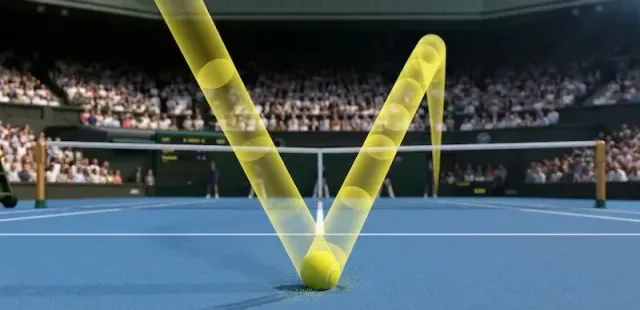
The Court Pace Index is a metric that quantifies the effective speed of a tennis court surface during live tournament play. It was developed using data from the Hawk-Eye tracking system and first appeared publicly in ATP broadcasts around 2016, when Tennis TV started including it in their coverage graphics.
The key word here is effective. CPI doesn't just measure the raw physical properties of the court material in isolation — it captures how the court is actually behaving during a real tournament, factoring in wear, atmospheric conditions, and ball behavior across thousands of shots.
Higher CPI = faster court. Lower CPI = slower court.
The CPI Formula: How It Is Actually Calculated
The official formula, as published by Tennis TV, is:
CPI = 100(1 − μ) + 150(0.81 − e)Where:
- μ (mu) = Coefficient of friction
- e = Coefficient of restitution
- 0.81 = Mean coefficient of restitution across all surface types (a constant used as the baseline reference)
- 150 = A "pace perception constant" that amplifies the effect of the COR component
Let's break down each variable.
Coefficient of Friction (μ): How much does the surface grab the ball?
Think of this as the "grip" of the court. When the ball hits the ground, friction is what slows it down horizontally — the more grip, the more pace the ball loses on the bounce. Clay grabs the ball a lot; grass barely grabs it at all. More grip = lower CPI = slower court.
Coefficient of Restitution (e): How high does the ball bounce?
This measures how much energy the ball keeps after hitting the ground — in simple terms, how high it bounces back. Here's where it gets counterintuitive: a higher bounce actually makes the court play slower, not faster. Why? Because a ball that sits up gives the opponent more time to get into position and wind up a full swing. A ball that stays low forces a rushed, defensive reply.
Clay produces a high, looping bounce — slow court. Grass produces a low, skidding bounce — fast court. The formula uses 0.81 as the average bounce level across all surfaces. Anything below that (ball bounces less than average) pushes the CPI up. Anything above it pulls the CPI down.
How Hawk-Eye Measures CPI: The Technology Behind It
CPI is not measured in a laboratory. CPI is calculated in real time from actual match play data.
The Hawk-Eye System
Hawk-Eye uses a network of 10 high-speed cameras installed around each court — 5 at each end — filming at 60 frames per second. The frame-by-frame footage is triangulated to produce a precise 3D trajectory of the ball at every moment from the instant it leaves the racquet to when it bounces and exits again.
The velocity change at the bounce — both horizontal and vertical — is what feeds directly into the friction and restitution calculations used in the CPI formula.
Which Courts Are Measured?
This is a crucial practical point that is almost never clearly stated in public coverage: CPI is only calculated from the main show courts at each venue — specifically the courts where Hawk-Eye cameras are permanently installed.
At most tournaments this means Court 1 (the main stadium court), and at larger venues potentially Court 2 as well if Hawk-Eye is deployed there.
Outer courts, qualifying courts, and practice courts are not measured for CPI. They may be physically different surfaces, built at different times, with different wear patterns — but they produce no CPI data. This is a significant blind spot if you're trying to use CPI for match analysis, since a large proportion of early-round matches at big tournaments are played on outer courts.
CPI Changes During a Tournament
The CPI value is not static. It is typically presented as a running average over the course of the tournament and tends to increase as the tournament progresses. Why?
Court surfaces contain sand particles in their top coat that create texture and friction. Player shoes progressively wear down these particles with each match played, producing a smoother surface. A smoother surface generates less friction when the ball makes contact — which directly raises the CPI value.
This means the court at Wimbledon in Round 1 and the court at Wimbledon in the final are, measurably, two different-speed courts. Early-round matches are played on a slower version of the surface.
At Which Tournaments Is CPI Published?
CPI data covers the top tier of the ATP calendar: the four Grand Slams, all nine Masters 1000 tournaments, and the ATP Finals. Below that level, coverage drops off sharply. Most ATP 500 events have partial data at best, and ATP 250s are largely absent from any CPI database — Hawk-Eye simply isn't deployed at that level consistently enough to generate reliable figures.
On the WTA side, CPI data is considerably less documented, though WTA events that share venues or broadcast infrastructure with ATP events (e.g., Indian Wells, Miami, Madrid) have some available data.
There is no centralized, official ATP or ITF repository where CPI is published in a systematic and downloadable format. The data has historically appeared in Tennis TV broadcast graphics and has been compiled by independent researchers and analysts. The best publicly available historical database as of early 2026 is courtspeed.com, which contains CPI measurements from 2012–2026 for Grand Slams and major ATP events.
How CPI Values Compare Across Tournaments
CPI values are grouped into five official speed categories:
| CPI Range | Category |
|---|---|
| < 30 | Slow |
| 30–34 | Medium-Slow |
| 35–39 | Medium |
| 40–44 | Medium-Fast |
| > 44 | Fast |
The table below uses real CPI data from courtspeed.com, the most complete public database available, covering 2012–2026. All-time CPI Avg is the historical mean across all years measured. 2-Year CPI reflects the two most recent editions and gives a more current picture of how the court is playing right now.
| Tournament | Surface | All-Time CPI Avg | Category (Avg) | 2-Year CPI | Category (2-Year) |
|---|---|---|---|---|---|
| Roland Garros | Clay | 21.0 | Slow | — | — |
| Madrid | Clay | 24.7 | Slow | 26.6 | Slow |
| Rome | Clay | 25.3 | Slow | 29.1 | Slow |
| Monte-Carlo | Clay | 27.0 | Slow | 29.1 | Slow |
| Indian Wells | Hard | 32.4 | Medium-Slow | 34.8 | Medium-Slow |
| Miami | Hard | 34.3 | Medium-Slow | 38.1 | Medium |
| Paris Bercy | Indoor Hard | 36.3 | Medium | 40.3 | Medium-Fast |
| Wimbledon | Grass | 37.0 | Medium | — | — |
| Cincinnati | Hard | 37.6 | Medium | 42.8 | Medium-Fast |
| Canadian Open | Hard | 38.7 | Medium | 41.2 | Medium-Fast |
| ATP Finals | Indoor Hard | 39.0 | Medium | 40.0 | Medium-Fast |
| Shanghai | Hard | 40.2 | Medium-Fast | 36.8 | Medium |
| US Open | Hard | 40.5 | Medium-Fast | — | — |
| Australian Open | Hard | 45.0 | Fast | — | — |
Note: Indian Wells 2026 figures are not yet available and will be added once the tournament wraps up.
The Real Limitations of CPI: What It Doesn't Tell You
CPI is the best publicly available real-time court speed metric in professional tennis. That doesn't mean it's complete. If you're using it for serious analysis, you need to understand where it falls short.
1. Only Main Show Courts
As mentioned, CPI only covers Hawk-Eye courts. A player who wins three matches on outer courts before reaching the semifinals has spent most of their tournament on a surface that was never measured.
2. No Altitude Adjustment
Altitude dramatically affects how the ball travels through the air. The clay courts in Madrid at 667 meters above sea level play substantially faster than the clay in Monte-Carlo at sea level — but if the surface CPI values were similar, you wouldn't know it from CPI alone. The ball spends far more time in the air than on the court surface, and CPI only measures the bounce.
3. Aggregated Averages Can Obscure Variation
Tournament-level CPI averages mask meaningful variation across individual match days. A tournament week in Paris with two days of rain and a cold snap will have different effective court speeds across the week — and the average CPI won't reflect that granularity.
4. No WTA-Specific Systematic Data
The WTA circuit has significantly less documented CPI coverage. For WTA-specific analysis, you are largely relying on the same tournament data from shared events with ATP, which is an incomplete picture.
Why CPI Matters for Tennis Analysis and Betting
Understanding what the CPI is — and what it isn't — has direct implications for anyone trying to build serious tennis models or identify betting edges.
Where CPI adds value:
- Comparing the same tournament across multiple years to identify whether courts have sped up or slowed down (e.g., detecting when a tournament director changed the surface formula)
- Identifying which hard court tournaments genuinely play differently, rather than relying on surface label alone
- Using court speed as a variable in player performance models, particularly for serve-dominant vs. baseline-dominant player matchups
Where CPI misleads:
- Using a single tournament CPI value as if it applies uniformly to all matches in that draw (it doesn't — outer courts, early rounds, and weather variations all create noise)
- Comparing CPI across surfaces without accounting for altitude
- Treating CPI as a fixed characteristic of a venue rather than a dynamic value that shifts throughout the tournament week
The honest bottom line: CPI is the best tool available for quantifying real court speed, but it has enough gaps and transparency issues that it should be used as one input among several — not as a definitive, standalone variable.


