

Betting Brokers: What I Learned After 20 Years of Tennis Betting
What are betting brokers? Complete guide with 20 years of experience. BetInAsia & MadMarket reviewed + exclusive 0.11% lifetime cashback.

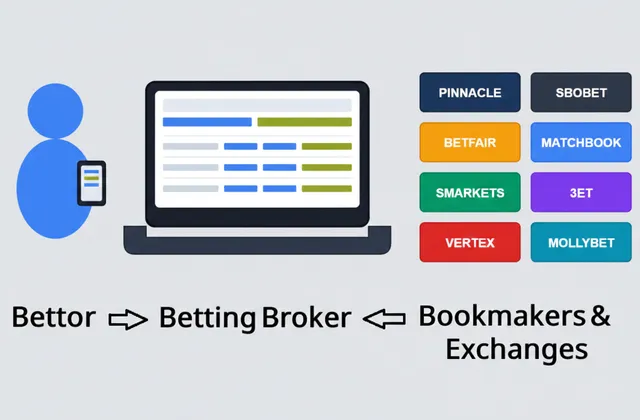
What Is a Betting Broker?
A betting broker (or betting agent) is an intermediary that gives you access to multiple sharp bookmakers and betting exchanges through a single account. Instead of managing separate accounts at Pinnacle, Betfair, and other sharp books, you deposit with the broker and they place bets on your behalf at the best available odds.
The key advantages: highest odds in the market, no account limits for winning, and everything centralized in one wallet.
I’ve been betting on tennis for over 20 years. That’s a long time in this game, and I believe what I’m about to tell you will be useful no matter where you live. Choosing the right place to place your bets is one of the most important decisions you’ll make. It can be the difference between winning and losing, or having a future in this world or not. It is that simple.
This is a long post and I’ve put a lot of detail into it. I suggest you save it for when you have some quiet time to read without being bothered.
Normally, bettors start with the most commercial sites, like Bet365, Bwin, William Hill, Ladbrokes, or Betfair in Europe—or DraftKings and FanDuel among others, in the US.
I was lucky enough to start with Betfair Exchange (the market, the good one, not the Betfair "soft" bookie—I’ll explain this later). I started there because the person who got me into this world used this exchange. If he had been betting at Bet365, I would have started there as well. Shortly after, I also signed-up at Pinnacle Sports, which is the bookmaker par excellence for professional bettors . I spent many years using both almost exclusively. Therefore, Betfair Exchange and Pinnacle where the two only places where I bet for many years.
The Golden Era of Market Inefficiency
Back then, in many matches the market was clearly inefficient. It wasn’t unusual to see odds and think, ‘wow’ — and you just don’t see that anymore. For example, if a high-ranked played a final on a Sunday in Europe and played again on Tuesday in America after a long flight and a surface change, the market barely reacted. The odds for the underdog were extremely high given those circumstamces. If you’ve also been betting on tennis for many years, you know that too. This is just one example. What I really mean is that there were often mispriced odds, far from their true equilibrium, and even when the market eventually corrected them before the match started, it took a long time to do so. That gave you enough time to enter at very good prices, with sufficient liquidity.
Those were great times for many tennis punters. If you took it seriously and worked hard, the tennis market was easy and you could achieve annual yields of 10–15% in liquid markets, what is not possible nowadays. And with that, if you were staking 1–2% per bet and placing several hundred bets per year, in 2–3 years you could multiply your bankroll several times. It’s a shame my bankroll was not big back then; otherwise, I would have made a lot of money. My more 'Pro' approach came a bit later, once I had more money to build a proper bankroll and could start placing much larger bets, at much lower ROIs.
Moreover, we didn’t have the strict legal restrictions we have now, at least in Europe. I know the US has followed a different path in terms of regulations.
The Shift: Efficiency and Regulation
That golden era ended as the market became progressively more efficient, information started to move much faster, and more and more bettors began to analyze the tennis market in a much deeper way — as I did. Also, and not less important, national regulators started imposing rules that forced Betfair Exchange and Pinnacle, among others, out of many countries.
That regulatory shift didn’t just remove a couple of great options — it completely changed the landscape. From that point on, where you could bet, and under what conditions, depended more on where you lived.
There were basically three types of places to bet:
Soft Bookies: Houses like Bet365. They have great marketing and attract recreational players who don't care much about the odds. Just like today, anyone could bet with these bookmakers. The problem? If you win, they limit you. Winning players are not welcome there. Sooner or later, they will cut your stakes to pennies or close your account. I’m not saying you shouldn't have an account with them—go ahead and use them while it lasts—but your time there will be limited if you have a long-term edge.
Exchanges: Platforms like Betfair, Matchbook, or Smarkets. Here you bet against other people, not the house. The platform just takes a commission. They won’t limit you because they don't lose when you win. It’s a fairer system, but you need liquidity (enough money in the market) to get good prices. But Betting Exchanges disappeared from many countries, mainly for 2 reasons. First, many national regulators (like those in France, Spain, or Italy) imposed "ring-fencing" laws, forcing residents to only bet against bettors in the same country. This killed the liquidity, making the odds uncompetitive compared to international markets. Second, the Governments usually tax bookmakers on their "Gross Gaming Revenue" (the players' net losses). In an exchange, the platform only earns a small commission. Regulators found it much harder—and less profitable—to collect taxes from this commission-based model compared to the traditional "soft bookie" model. In other words, the regulators made it too expensive for these companies to operate in certain countries.
Pinnacle Sports: They are unique. Their risk management is so good that they are practically the only house that offers top odds and high limits without banning winners. They actually use the bets from smart players to sharpen their odds. It is the professional house, period. Also, since they operate on a low-margin, high-volume model, the taxes they were required to pay made it unprofitable to operate in many markets, which they eventually had to leave.
In the end, it’s also true that pressure from soft bookmakers and their lobbies has had a big influence on regulators, pushing to remove competition from exchanges and Pinnacle, which offer much better odds and don’t limit winners. This has been confirmed to me by people inside the industry, and it makes complete sense.
My Transition to Betting Brokers
Well, after these changes, I managed to keep my Betfair Exchange account for reasons I won’t get into here, but I lost Pinnacle. It was a shock, and my performance dropped quite a bit. I spent some time only using Betfair, but it wasn't enough, I was like a lost soul without Pinnacle.
But a few months later, while I was looking for ways to bet at Pinnacle through other means, I discovered betting brokers, and that changed everything. I vaguely remembered having heard about them before, but it was a very opaque world with hardly any reliable information.
I remember I first opened an account in the broker Bet-Football and afterwards in Sportmarket. Both of them worked very well, and I had no problems at all. I had access to Pinnacle through them, so it was great to be able to bet at Pinny again, even if it was through a broker.
I’ll talk about this in more detail later, but even though brokers didn’t apply for local gambling licenses, they used to allow almost everyone to bet — maybe with the exception of the US, although I’m not sure about when they started restricting US players.
What is a Betting Broker?
A betting broker (or betting agent) is an intermediary that gives you access to several "sharp" books and exchanges with one single account. This includes Pinnacle (via its white-label PS3838), Betfair liquidity (via white-labels like Sharp Exchange), and other sharp books like Vertex, SBOBet or 3et.
The main advantages of betting through a broker are the following:
- Intermediary: You bet through the broker; they place the bet at the best price. Most brokers use platforms like Mollybet, where you get the best real-time price from all available books and exchanges. If you have Pinnacle at 1.95 and another book or exchange at 1.98 — their platform automatically bets at 1.98.
- Everything is centralized in a single account: You don't need to manage different betting accounts. You use one platform, one wallet, and bet everywhere through it. So you don’t have to move money between different bookmakers when you run out of money in one of them — which is very normal if you bet in several.
- Better odds, high limits: They aggregate the best prices from everywhere. And they don't limit you for winning. Having access to the odds from all the exchanges and bookmakers, means that a broker gives you, without doubt, the highest odds on the market. It’s that simple. Nobody can beat the prices you can get through a broker. Also, because they offer access to several bookmakers, the limits are high and they welcome winning players.
- No bans: The broker wants you to bet as much as possible, because they earn a commission on the volume (turnover) you place. The exact percentage depends on the broker, the book, and your activity, but it's estimated to be a small fraction of your turnover — around 0.3-0.5% regardless of whether you win or lose, from what I've gathered talking to people in the industry. This means they actually want you to win and stay with them for a long time.
- Low or no fees. Brokers don't usually charge players for placing bets; as I said, they're compensated through rebates from the operators. Some may charge withdrawal fees if turnover requirements aren't met. When accessing exchanges via brokers, commission is around 2.5-3% — lower than Betfair's standard 5% — and you avoid their Expert Fee, what is an extra commissions charged by Betfair Exchange for the biggest winners, that can reach 40% of your profits.
- Anonymity: It’s great for players who want to keep their activity private or have been banned elsewhere. Only the broker knows who you are, but the exchanges and bookmakers don’t — you are invisible to them.
There are several brokers in the market like BetInAsia, MadMarket, SportMarket, Asianconnect, Premium Tradings, VOdds, Bet-Football or Bet-IBC.
The Legal Aspect
Bet brokers also face regulatory restrictions and aren't available in every country. This is a grey area. It depends on the broker and your country. Some are stricter than others. Some accept countries that others don't. Many of these platforms operate under international licenses in offshore jurisdictions, which allows them to offer their services globally.
The reality is that while a broker might be perfectly legal in its own jurisdiction, your local laws might not explicitly recognize or regulate them. I can’t possibly keep up with the gambling legislation of all 200 countries in the world, so it is your responsibility to know the rules where you live. What is clear is that many bettors use brokers even if their country of residence doesn’t allow it. That’s a personal decision.
For professional bettors or those living in 'closed' markets, brokers are often the only way to access high odds and high limits. I’ve personally used them for years without issues, focusing on the platforms that have proven their reliability over time.
My Personal Setup: Where I Bet Today
And now I’ll share my personal experience. For the last few years, the broker I've been using is BetInAsia, which, despite the name, are not based in Asia :-). Their operational base in Malta.
Most betting brokers offer access to the same bookmakers and exchanges, so choosing one over another mainly comes down to whether they accept players from your country, how easy the platform is to use, and how long they’ve been in the market. BetInAsia has been operating since 2011. The country I live in now allows me to use BetInAsia and the withdrawal fees are also very low — or even free if you withdraw once per month.
On top of that, they offered me a lifetime cashback on all my bets — and if you bet significant volume year after year, that really adds up. No other broker ever offered me something like this, and over time it does make a meaningful difference.
Because of that, I asked them to make the same conditions available to people who read me. So if you sign up at BetInasia here and use the code CBNISHI, you’ll get an exclusive 0.11% lifetime cashback in all your bets, win or lose.
The only caveat is that they aren’t available everywhere, so you should first check their sign-up form to see if your country is accepted. Even if your country is listed, you may still need a VPN to access the site. Several locations work well for this — Belgium is one example.
If BetInAsia works for you, you are lucky.
Alternative 1: MadMarket (broker)
But if it doesn't work for you, it is not all lost. You can check out the broker MadMarket. They accept more countries. I also got the exclusive 0.11% cashback for life for you if you register in MadMarket here (no code needed). The platform is solid and has practically the same houses and exchanges. I’ve tried it myself, and it works perfectly. They are a newer player compared to BetInAsia, as they entered the market in 2024. But I know the people behind it, and they give me full confidence. That’s why I’m comfortable recommending MadMarket as a solid alternative if BetInAsia doesn’t work for you.
Like most brokers, MadMarket uses MollyBet technology. This is the aggregation software used by almost all professional brokers; it’s what allows you to see all the odds on a single screen and ensures the platform automatically selects the best available price when you place your bet. Just like with BetInAsia, you can check on their sign-up form whether MadMarket accept players from your country. In some countries they only accept crypto, although more and more are starting to accept fiat currencies as well.
Alternative 2: Bet105 (bookmaker)
If you’ve checked BetInAsia and it’s not available in your country, and you’ve also checked MadMarket and it’s not available either, the third option is the bookmaker Bet105, which is accesible for bettors anywhere in the world.
Bet105 is part of the Sports Heritage Group, which has operated since 2001. They focus mainly on crypto and offer high odds, high limits, and no restrictions on winning players. It is available worldwide — that’s the real advantage. In most cases, no KYC is required, so you don’t need to disclose your address or even your real name to open an account. The only downside is that Bet105 only accepts cryptocurrency, but that’s exactly what allows it to stay global, fast, and anonymous.
Bet105 is not a broker, it is a bookmaker for sharp bettors that works with very low margins, so the odds they offer are very good. They are not as high as what you can get through a broker — where you always take the best price among many — but they are still high.
For bettors in restricted markets who can use crypto, Bet105 is the most practical option. I’ve also spoken directly with them, and if you sign up in Bet105 here and use the code NISHI, you’ll get an exclusive free bet of $100 if you deposit at $200.
To Wrap up
These are my three picks for betting without restrictions:
- BetInAsia
- MadMarket (if BetInAsia is blocked)
- Bet105 (if MadMarket is blocked or if you want no KYC and can use crypto)
At the end of the day, people give a lot of betting advice (I do it too), but I’m sure the most important thing is this: you must bet at the highest odds possible and use platforms that accept high stakes and won't ban you for winning.
If you take 2.10 instead of 2.05, it doesn’t seem like a big deal for just one bet. But the math tells a different story. Over the years, you are leaving a lot of money on the table if you keep accepting 2.05. And when you factor in compound interest, the difference after a few years is huge. This is why getting around those local restrictions and finding a way to reach these professional markets is so important. It’s not just about access; it’s about making sure you aren't losing money for no reason.
Transparency Note: I have negotiated exclusive terms for this community—such as the 0.11% lifetime cashback—that you won't find by signing up directly or anywhere else. I earn a small commission if you use these links, but I wouldn’t do it if I didn’t believe they are the best options available, taking all variables into account. In other words, I chose which brokers to feature in this article — not the other way around. I bet regularly in BetInAsia and I have also tested and bet from time to time in MadMarket and Bet105.
Legal Disclaimer: This article reflects my personal experience and is for informational purposes only. I am not a financial or legal advisor. Betting laws vary by country; please ensure you comply with your local regulations. I am not responsible for any financial losses or the solvency of the mentioned platforms. Gamble responsibly.


